Ch. 2 - Limits and Continuity
Hass - Thomas' Calculus 15th Edition
Hass15th EditionThomas' CalculusISBN: 9780137616077Non è quello che usi tu?Cambia libro di testo
Capitolo 2, Problema 2.6.70

Domains and Asymptotes


Determine the domain of each function in Exercises 69–72. Then use various limits to find the asymptotes.


y = 2x / (x² − 1)

Guida verificata passo dopo passo
1
To determine the domain of the function \( y = \frac{2x}{x^2 - 1} \), identify the values of \( x \) that make the denominator zero, as these are the points where the function is undefined. Set \( x^2 - 1 = 0 \) and solve for \( x \).
Solve the equation \( x^2 - 1 = 0 \) by factoring it as \( (x - 1)(x + 1) = 0 \). This gives the solutions \( x = 1 \) and \( x = -1 \). Therefore, the domain of the function is all real numbers except \( x = 1 \) and \( x = -1 \).
Next, find the vertical asymptotes by examining the behavior of the function as \( x \) approaches the values that make the denominator zero. Calculate the limits \( \lim_{x \to 1^+} \frac{2x}{x^2 - 1} \), \( \lim_{x \to 1^-} \frac{2x}{x^2 - 1} \), \( \lim_{x \to -1^+} \frac{2x}{x^2 - 1} \), and \( \lim_{x \to -1^-} \frac{2x}{x^2 - 1} \).
To find horizontal asymptotes, consider the limit of the function as \( x \) approaches infinity. Calculate \( \lim_{x \to \infty} \frac{2x}{x^2 - 1} \) and \( \lim_{x \to -\infty} \frac{2x}{x^2 - 1} \).
Analyze the results of these limits: if the limit approaches a finite number as \( x \to \infty \) or \( x \to -\infty \), that number is the horizontal asymptote. If the limits as \( x \to 1 \) or \( x \to -1 \) approach infinity, these are vertical asymptotes.

Risposta video verificata per un problema simile:

Questa soluzione video è stata consigliata dai nostri tutor come utile per risolvere questo problema.
Durata del video:
3m

Concetti chiave

Ecco i concetti essenziali che devi comprendere per rispondere correttamente alla domanda.

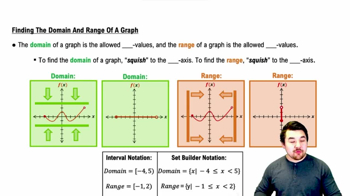
Domain of a Function

The domain of a function is the set of all possible input values (x-values) for which the function is defined. For rational functions like y = 2x / (x² − 1), the domain excludes values that make the denominator zero, as division by zero is undefined. In this case, x² − 1 = 0 when x = ±1, so the domain is all real numbers except x = ±1.
Video consigliato:
Percorso guidato
5:10
Finding the Domain and Range of a Graph

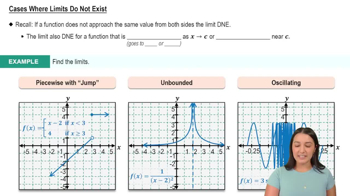
Limits and Asymptotes

Limits help determine the behavior of a function as it approaches a particular point or infinity. Vertical asymptotes occur where the function approaches infinity, typically where the denominator is zero. Horizontal asymptotes describe the function's behavior as x approaches infinity. For y = 2x / (x² − 1), vertical asymptotes are at x = ±1, and the horizontal asymptote is y = 0, as the degree of the denominator is greater than the numerator.
Video consigliato:
03:07
Cases Where Limits Do Not Exist

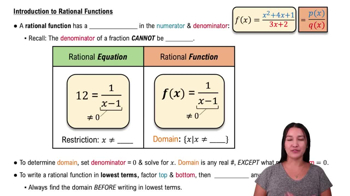
Rational Functions

A rational function is a ratio of two polynomials. The behavior of rational functions is often analyzed by examining their domains, asymptotes, and intercepts. Understanding the structure of the numerator and denominator helps predict the function's graph. For y = 2x / (x² − 1), the numerator is linear, and the denominator is quadratic, influencing the function's asymptotic behavior and domain restrictions.
Video consigliato:
6:04
Intro to Rational Functions