Ch. 2 - Limits and Continuity
Hass - Thomas' Calculus 15th Edition
Hass15th EditionThomas' CalculusISBN: 9780137616077Non è quello che usi tu?Cambia libro di testo
Capitolo 2, Problema 2d

Finding Limits Graphically


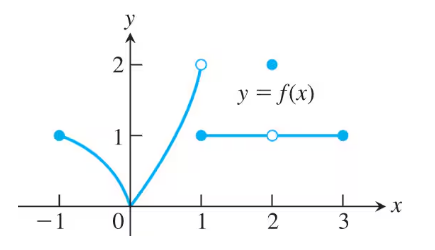
Which of the following statements about the function y = f(x) graphed here are true, and which are false?


img


d. limx→1− f(x) = 2

Guida verificata passo dopo passo
1
To determine the limit \( \lim_{x \to 1^-} f(x) = 2 \), we need to analyze the behavior of the function \( f(x) \) as \( x \) approaches 1 from the left side (i.e., values of \( x \) that are slightly less than 1).
Examine the graph of the function \( y = f(x) \) and observe the values of \( f(x) \) as \( x \) gets closer to 1 from the left. Look for the y-values that the function approaches.
Identify the y-value that \( f(x) \) is approaching as \( x \) approaches 1 from the left. This is the left-hand limit, denoted as \( \lim_{x \to 1^-} f(x) \).
Check if the y-value that \( f(x) \) approaches from the left is equal to 2. If the graph shows that the function approaches a y-value of 2 as \( x \) approaches 1 from the left, then the statement is true.
If the y-value that \( f(x) \) approaches from the left is not equal to 2, then the statement is false. Conclude based on the observed behavior of the graph.

Risposta video verificata per un problema simile:

Questa soluzione video è stata consigliata dai nostri tutor come utile per risolvere questo problema.
Durata del video:
3m

Concetti chiave

Ecco i concetti essenziali che devi comprendere per rispondere correttamente alla domanda.

Limits

A limit is a fundamental concept in calculus that describes the behavior of a function as its input approaches a certain value. It helps in understanding how functions behave near specific points, even if they are not defined at those points. For example, the limit of f(x) as x approaches 1 from the left (denoted as lim x→1− f(x)) examines the values f(x) takes as x gets closer to 1 from values less than 1.
Video consigliato:
05:50
One-Sided Limits

One-Sided Limits

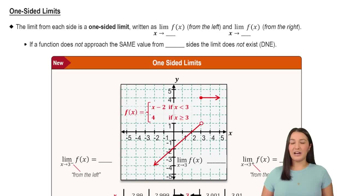
One-sided limits refer to the limits of a function as the input approaches a specific value from one side only. The left-hand limit (lim x→c− f(x)) considers values approaching c from the left, while the right-hand limit (lim x→c+ f(x)) considers values approaching c from the right. Understanding one-sided limits is crucial for analyzing functions that may have different behaviors on either side of a point.
Video consigliato:
05:50
One-Sided Limits

Graphical Interpretation of Limits

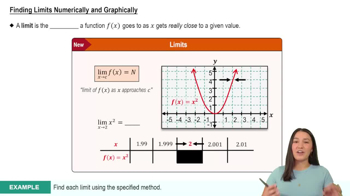
Graphical interpretation of limits involves analyzing the graph of a function to determine the value that the function approaches as the input approaches a certain point. By observing the behavior of the graph near that point, one can visually assess whether the limit exists and what its value is. This method is particularly useful for identifying discontinuities or jumps in the function's values.
Video consigliato:
6:47
Finding Limits Numerically and Graphically