Ch. 2 - Limits and Continuity
Hass - Thomas' Calculus 15th Edition
Hass15th EditionThomas' CalculusISBN: 9780137616077Non è quello che usi tu?Cambia libro di testo
Capitolo 2, Problema 2.7c

Limits and Continuity
On what intervals are the following functions continuous?


c. h(x) = x⁻²/³

Guida verificata passo dopo passo
1
Identify the type of function: The function h(x) = x-2/3 is a power function, which is generally continuous wherever it is defined.
Determine the domain of the function: Since h(x) involves x raised to a negative fractional power, we need to consider where the expression is defined. Specifically, x-2/3 is undefined for x = 0 because it involves division by zero.
Consider the behavior at x = 0: The expression x-2/3 can be rewritten as 1/(x2/3), which is undefined at x = 0. Therefore, the function is not continuous at x = 0.
Identify intervals of continuity: Since the function is undefined at x = 0, it is continuous on the intervals where it is defined, which are (-∞, 0) and (0, ∞).
Conclude the intervals of continuity: The function h(x) = x-2/3 is continuous on the intervals (-∞, 0) and (0, ∞).

Risposta video verificata per un problema simile:

Questa soluzione video è stata consigliata dai nostri tutor come utile per risolvere questo problema.
Durata del video:
2m

Concetti chiave

Ecco i concetti essenziali che devi comprendere per rispondere correttamente alla domanda.

Limits

Limits are fundamental in calculus, representing the value that a function approaches as the input approaches a certain point. Understanding limits is crucial for analyzing the behavior of functions, especially at points where they may not be explicitly defined, such as discontinuities or asymptotes.
Video consigliato:
05:50
One-Sided Limits

Continuity

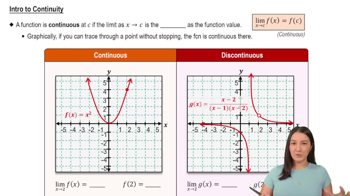
A function is continuous at a point if the limit of the function as it approaches that point equals the function's value at that point. For a function to be continuous over an interval, it must be continuous at every point within that interval, which involves checking for any breaks, jumps, or asymptotic behavior.
Video consigliato:
05:34
Intro to Continuity

Domain of a Function

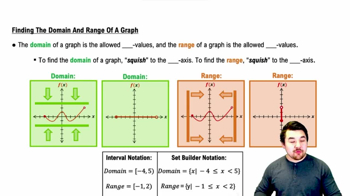
The domain of a function is the set of all possible input values (x-values) for which the function is defined. Identifying the domain is essential for determining continuity, as functions may be undefined at certain points, leading to discontinuities that affect the overall behavior of the function.
Video consigliato:
Percorso guidato
5:10
Finding the Domain and Range of a Graph