Ch. 2 - Limits and Continuity
Hass - Thomas' Calculus 15th Edition
Hass15th EditionThomas' CalculusISBN: 9780137616077Non è quello che usi tu?Cambia libro di testo
Capitolo 2, Problema 3h

Limits and Continuity


Suppose that ƒ(t) and ƒ(t) are defined for all t and that lim t → t₀ ƒ(t) = ―7 and lim (t → t₀) g (t) = 0 . Find the limit as t → t₀ of the following functions.
h. 1 / ƒ(t)

Guida verificata passo dopo passo
1
Identify the given limits: lim t → t₀ ƒ(t) = -7 and lim t → t₀ g(t) = 0. We need to find lim t → t₀ of 1/ƒ(t).
Recall the limit property for the reciprocal function: If lim t → t₀ ƒ(t) = L and L ≠ 0, then lim t → t₀ 1/ƒ(t) = 1/L.
Apply the property to the given function: Since lim t → t₀ ƒ(t) = -7 and -7 ≠ 0, we can use the reciprocal limit property.
Substitute the limit value into the reciprocal property: lim t → t₀ 1/ƒ(t) = 1/(-7).
Conclude that the limit of 1/ƒ(t) as t approaches t₀ is the reciprocal of -7, which is -1/7.

Risposta video verificata per un problema simile:

Questa soluzione video è stata consigliata dai nostri tutor come utile per risolvere questo problema.
Durata del video:
2m

Concetti chiave

Ecco i concetti essenziali che devi comprendere per rispondere correttamente alla domanda.

Limits

A limit describes the value that a function approaches as the input approaches a certain point. In this context, the limit of ƒ(t) as t approaches t₀ is given as -7, indicating that as t gets closer to t₀, ƒ(t) gets closer to -7. Understanding limits is crucial for analyzing the behavior of functions near specific points, especially when dealing with continuity and discontinuity.
Video consigliato:
05:50
One-Sided Limits

Continuity

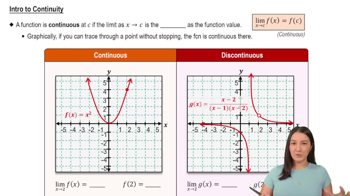
A function is continuous at a point if the limit of the function as it approaches that point equals the function's value at that point. In this case, since lim t → t₀ ƒ(t) = -7, we can infer that ƒ(t) is continuous at t₀ if ƒ(t₀) is also -7. Continuity is essential for ensuring that limits can be evaluated without encountering undefined behavior.
Video consigliato:
05:34
Intro to Continuity

Reciprocal Limits

The limit of the reciprocal of a function, such as 1/ƒ(t), can be evaluated using the limit of the function itself. If lim t → t₀ ƒ(t) = -7, then lim t → t₀ (1/ƒ(t)) = 1/(-7) = -1/7, provided that ƒ(t) does not approach zero. This concept is important for understanding how limits behave under operations like taking reciprocals.
Video consigliato:
05:50
One-Sided Limits