Ch. 2 - Limits and Continuity
Hass - Thomas' Calculus 15th Edition
Hass15th EditionThomas' CalculusISBN: 9780137616077Non è quello che usi tu?Cambia libro di testo
Capitolo 2, Problema 4f

Limits and Continuity


Suppose the functions ƒ(x) and g(x) are defined for all x and that lim (x → 0) ƒ(x) = 1/2 and lim (x → 0) g(x) = √2. Find the limits as x → 0 of the following functions.


f. [ƒ(x) • cos x ] / x―1

Guida verificata passo dopo passo
1
First, identify the limit expression you need to evaluate: lim (x → 0) [ƒ(x) • cos x] / (x - 1).
Recognize that the limit involves a product of functions and a division. We can use the limit properties to separate the functions: lim (x → 0) [ƒ(x) • cos x] / (x - 1) = lim (x → 0) [ƒ(x) • cos x] / lim (x → 0) (x - 1), provided the limits exist and the denominator is not zero.
Evaluate the limit of the numerator: lim (x → 0) [ƒ(x) • cos x]. Since lim (x → 0) ƒ(x) = 1/2 and lim (x → 0) cos x = cos(0) = 1, use the product rule for limits: lim (x → 0) [ƒ(x) • cos x] = (1/2) • 1 = 1/2.
Evaluate the limit of the denominator: lim (x → 0) (x - 1). This is a straightforward limit: lim (x → 0) (x - 1) = 0 - 1 = -1.
Combine the results from the numerator and denominator: lim (x → 0) [ƒ(x) • cos x] / (x - 1) = (1/2) / (-1) = -1/2. Therefore, the limit is -1/2.

Risposta video verificata per un problema simile:

Questa soluzione video è stata consigliata dai nostri tutor come utile per risolvere questo problema.
Durata del video:
2m

Concetti chiave

Ecco i concetti essenziali che devi comprendere per rispondere correttamente alla domanda.

Limits

Limits are fundamental in calculus, representing the value that a function approaches as the input approaches a certain point. In this question, understanding how to evaluate limits as x approaches 0 is crucial, especially when dealing with functions that may not be defined at that point. The limit helps in determining the behavior of the function near that point, which is essential for solving the problem.
Video consigliato:
05:50
One-Sided Limits

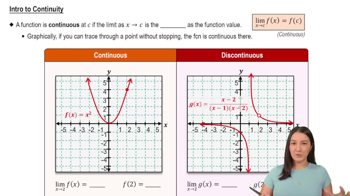
Continuity

A function is continuous at a point if the limit of the function as it approaches that point equals the function's value at that point. In this context, continuity ensures that the functions ƒ(x) and g(x) behave predictably around x = 0, allowing us to apply limit properties effectively. Understanding continuity helps in analyzing the behavior of composite functions, especially when limits are involved.
Video consigliato:
05:34
Intro to Continuity

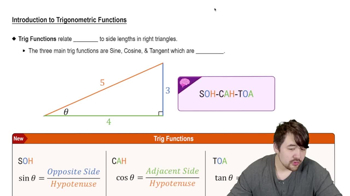
Trigonometric Limits

Trigonometric limits, such as those involving cos(x), are important in calculus as they often appear in limit problems. The limit of cos(x) as x approaches 0 is 1, which simplifies the evaluation of limits involving trigonometric functions. Recognizing these standard limits allows for easier manipulation and calculation of more complex expressions, such as the one presented in the question.
Video consigliato:
Percorso guidato
6:04
Introduction to Trigonometric Functions