Ch. 2 - Limits and Continuity
Hass - Thomas' Calculus 15th Edition
Hass15th EditionThomas' CalculusISBN: 9780137616077Non è quello che usi tu?Cambia libro di testo
Capitolo 2, Problema 2.2.59

Limits of Average Rates of Change


Because of their connection with secant lines, tangents, and instantaneous rates, limits of the form limh→0 (f(x+h) − f(x)) / h occur frequently in calculus. In Exercises 57–62, evaluate this limit for the given value of x and function f.


f(x) = 3x - 4, x = 2

Guida verificata passo dopo passo
1
Identify the function f(x) = 3x - 4 and the point x = 2 where we need to evaluate the limit.
Substitute f(x) and f(x+h) into the limit expression: lim(h→0) [(f(x+h) - f(x)) / h]. This becomes lim(h→0) [(3(x+h) - 4) - (3x - 4)] / h.
Simplify the expression inside the limit: (3(x+h) - 4) - (3x - 4) simplifies to 3x + 3h - 4 - 3x + 4, which further simplifies to 3h.
The limit expression now becomes lim(h→0) [3h / h]. Simplify this expression by canceling h in the numerator and denominator, resulting in lim(h→0) [3].
Since the expression is now a constant, the limit as h approaches 0 is simply the constant value, which is 3.

Risposta video verificata per un problema simile:

Questa soluzione video è stata consigliata dai nostri tutor come utile per risolvere questo problema.
Durata del video:
3m

Concetti chiave

Ecco i concetti essenziali che devi comprendere per rispondere correttamente alla domanda.

Limits

In calculus, a limit is a fundamental concept that describes the behavior of a function as its input approaches a certain value. It helps in understanding how functions behave near specific points, which is crucial for defining derivatives and integrals. The notation lim h→0 f(x+h) indicates examining the function f as the increment h approaches zero, allowing us to analyze instantaneous rates of change.
Video consigliato:
05:50
One-Sided Limits

Average Rate of Change

The average rate of change of a function over an interval is calculated as the change in the function's value divided by the change in the input value. Mathematically, it is expressed as (f(b) - f(a)) / (b - a) for the interval [a, b]. This concept is essential for understanding how a function behaves over an interval and serves as a foundation for the more precise instantaneous rate of change, which is explored through limits.
Video consigliato:
Percorso guidato
06:37
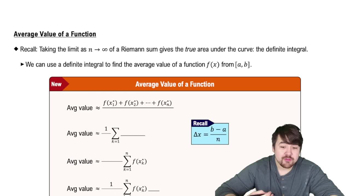
Average Value of a Function

Derivative

The derivative of a function at a point represents the instantaneous rate of change of the function with respect to its variable. It is defined as the limit of the average rate of change as the interval approaches zero, formally expressed as f'(x) = lim h→0 (f(x+h) - f(x)) / h. Derivatives are crucial in calculus for analyzing the behavior of functions, finding slopes of tangent lines, and solving optimization problems.
Video consigliato: