Ch. 2 - Limits and Continuity
Hass - Thomas' Calculus 15th Edition
Hass15th EditionThomas' CalculusISBN: 9780137616077Non è quello che usi tu?Cambia libro di testo
Capitolo 2, Problema 2.2.55b

Suppose limx→b f(x) = 7 and lim x→b g(x) = −3. Find


b. limx→b f(x)⋅g(x)

Guida verificata passo dopo passo
1
First, understand the concept of limits. A limit describes the value that a function approaches as the input approaches a certain point. In this problem, we are given the limits of two functions, f(x) and g(x), as x approaches b.
Next, recall the limit multiplication rule: if lim(x→b) f(x) = L and lim(x→b) g(x) = M, then lim(x→b) [f(x)⋅g(x)] = L⋅M. This rule allows us to multiply the limits of two functions directly.
Apply the limit multiplication rule to the given limits: lim(x→b) f(x) = 7 and lim(x→b) g(x) = -3. According to the rule, the limit of the product f(x)⋅g(x) as x approaches b is the product of the individual limits.
Calculate the product of the limits: multiply the limit of f(x), which is 7, by the limit of g(x), which is -3. This gives you the limit of the product f(x)⋅g(x) as x approaches b.
Finally, conclude that the limit of the product f(x)⋅g(x) as x approaches b is the result of the multiplication you performed in the previous step.

Risposta video verificata per un problema simile:

Questa soluzione video è stata consigliata dai nostri tutor come utile per risolvere questo problema.
Durata del video:
1m

Concetti chiave

Ecco i concetti essenziali che devi comprendere per rispondere correttamente alla domanda.

Limit of a Function

The limit of a function describes the value that a function approaches as the input approaches a certain point. In this case, limx→b f(x) = 7 indicates that as x gets closer to b, the function f(x) approaches the value 7. Understanding limits is fundamental in calculus as it lays the groundwork for concepts like continuity and derivatives.
Video consigliato:
06:11
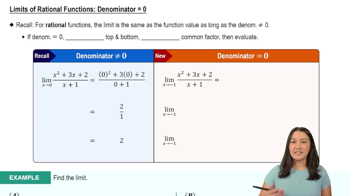
Limits of Rational Functions: Denominator = 0

Product of Limits

The product of limits states that if the limits of two functions exist as x approaches a certain value, then the limit of their product is the product of their limits. Specifically, if limx→b f(x) = L and limx→b g(x) = M, then limx→b (f(x)⋅g(x)) = L⋅M. This property is essential for solving problems involving the multiplication of functions at a limit.
Video consigliato:
05:18
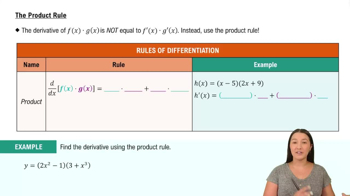
The Product Rule

Evaluating Limits

Evaluating limits involves substituting values or applying limit laws to find the limit of a function as it approaches a specific point. In this scenario, to find limx→b f(x)⋅g(x), one would substitute the known limits of f(x) and g(x) into the product of limits formula, resulting in 7⋅(−3) = −21. This process is crucial for solving limit problems in calculus.
Video consigliato:
05:50
One-Sided Limits