Ch. 2 - Limits and Continuity
Hass - Thomas' Calculus 15th Edition
Hass15th EditionThomas' CalculusISBN: 9780137616077Non è quello che usi tu?Cambia libro di testo
Capitolo 2, Problema 2.2.53

Suppose limx→c f(x) = 5 and lim x→c g(x) = −2. Find


b. limx→c 2f(x)g(x)

Guida verificata passo dopo passo
1
First, understand that the problem involves finding the limit of a product of functions as x approaches a certain value, c.
Recall the limit property for products: if lim(x→c) f(x) = L and lim(x→c) g(x) = M, then lim(x→c) [f(x) * g(x)] = L * M.
In this problem, you are given that lim(x→c) f(x) = 5 and lim(x→c) g(x) = -2.
Apply the limit property for products to find lim(x→c) [2 * f(x) * g(x)]. This can be rewritten as 2 * lim(x→c) [f(x) * g(x)].
Substitute the known limits into the expression: 2 * (5 * -2). Calculate this expression to find the limit.

Risposta video verificata per un problema simile:

Questa soluzione video è stata consigliata dai nostri tutor come utile per risolvere questo problema.
Durata del video:
1m

Concetti chiave

Ecco i concetti essenziali che devi comprendere per rispondere correttamente alla domanda.

Limit of a Function

The limit of a function describes the value that a function approaches as the input approaches a certain point. In this case, limx→c f(x) = 5 indicates that as x gets closer to c, the function f(x) approaches the value 5. Understanding limits is fundamental in calculus as it lays the groundwork for concepts like continuity and derivatives.
Video consigliato:
06:11
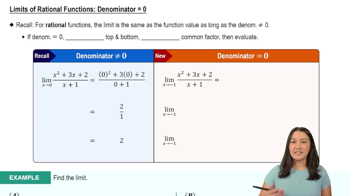
Limits of Rational Functions: Denominator = 0

Product of Limits

The product of limits states that if the limits of two functions exist as x approaches a certain value, then the limit of their product can be found by multiplying the individual limits. Specifically, if limx→c f(x) = L and limx→c g(x) = M, then limx→c (f(x)g(x)) = L * M. This property is essential for solving the given limit problem involving the functions f(x) and g(x).
Video consigliato:
05:18
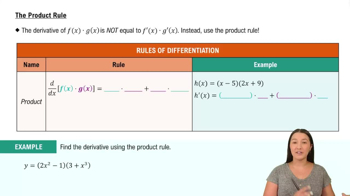
The Product Rule

Constant Multiplication in Limits

When calculating limits, multiplying a function by a constant does not affect the limit's existence. Specifically, if k is a constant and limx→c f(x) = L, then limx→c (k * f(x)) = k * L. This concept is crucial for evaluating the limit limx→c 2f(x)g(x), as the constant 2 can be factored out when calculating the limit.
Video consigliato:
05:50
One-Sided Limits
Pratica correlata
Domanda del libro di testo

At what points are the functions in Exercises 13–30 continuous?

y = (2x – 1)¹/³

212
views

Domanda del libro di testo

Infinite Limits


Find the limits in Exercises 37–48. Write ∞ or −∞ where appropriate.


lim x→−5⁻ (3x) / (2x + 10)

335
views
Domanda del libro di testo

In Exercises 77–80, find a function that satisfies the given conditions and sketch its graph. (The answers here are not unique. Any function that satisfies the conditions is acceptable. Feel free to use formulas defined in pieces if that will help.)


lim x → ±∞ k(x) = 1, lim x → 1⁻ k(x) = ∞, and lim x → 1⁺ k(x) = −∞

289
views
Domanda del libro di testo

Using the Sandwich Theorem


a. Suppose that the inequalities 1/2 − x² / 24 < (1 − cos x)/ x² < 1/2 hold for values of x close to zero, except for x = 0 itself. (They do, as you will see in Section 9.9.) What, if anything, does this tell you about limx→0 (1 −cos x)/ x²?


Give reasons for your answer.


[Technology Exercise] b. Graph the equations y=(1/2) − (x²/24), y = (1 - cos x) / x², and y = 1/2 together for −2 ≤ x ≤2. Comment on the behavior of the graphs as x→0.

380
views
Domanda del libro di testo

Use formal definitions to prove the limit statements in Exercises 93–96.


lim x → −5 (1 / (x + 5)²) = ∞

294
views
Domanda del libro di testo

Finding Limits


In Exercises 3–8, find the limit of each function (a) as x → ∞ and (b) as x → −∞. (You may wish to visualize your answer with a graphing calculator or computer.)


g(x) = 1/(2 + (1/x))

322
views