Ch. 2 - Limits and Continuity
Hass - Thomas' Calculus 15th Edition
Hass15th EditionThomas' CalculusISBN: 9780137616077Non è quello che usi tu?Cambia libro di testo
Capitolo 2, Problema 2.2.51

Using Limit Rules


Suppose lim x→0 f(x) = 1 and lim x→0 g(x) = −5. Name the rules in Theorem 1 that are used to accomplish steps (a), (b), and (c) of the following calculation.


limx→0 (2f(x) − g(x)) / (f(x) + 7)² = limx→0 (2f(x) − g(x)) / limx→0 (f(x) + 7)² (a)


(We assume the denominator is nonzero.)


(lim x→0 2f(x) − lim x→0 g(x)) / (lim x→0 (f(x) + 7))² (b)


= (2 lim x→0 f(x) − lim x→0 g(x)) / (lim x→0 f(x) + lim x→0 7)² (c)


= ((2)(1) − (−5)) / (1 + 7)² = 7/64

Guida verificata passo dopo passo
1
Step 1: Identify the limit expression given: lim_{x→0} (2f(x) − g(x)) / (f(x) + 7)². We need to apply limit rules to simplify this expression.
Step 2: Apply the Quotient Rule for limits, which states that lim_{x→a} [u(x)/v(x)] = [lim_{x→a} u(x)] / [lim_{x→a} v(x)], provided lim_{x→a} v(x) ≠ 0. This allows us to separate the limit of the numerator and the denominator.
Step 3: For the numerator, apply the Sum/Difference Rule for limits: lim_{x→a} [u(x) ± v(x)] = lim_{x→a} u(x) ± lim_{x→a} v(x). This lets us separate the terms 2f(x) and -g(x) into individual limits.
Step 4: For the term 2f(x), apply the Constant Multiple Rule: lim_{x→a} [c * u(x)] = c * lim_{x→a} u(x). This allows us to take the constant 2 out of the limit.
Step 5: For the denominator, apply the Sum Rule and the Constant Rule: lim_{x→a} [u(x) + c] = lim_{x→a} u(x) + c, where c is a constant. This simplifies the denominator to (lim_{x→0} f(x) + 7)².

Risposta video verificata per un problema simile:

Questa soluzione video è stata consigliata dai nostri tutor come utile per risolvere questo problema.
Durata del video:
4m

Concetti chiave

Ecco i concetti essenziali che devi comprendere per rispondere correttamente alla domanda.

Limit of a Function

The limit of a function describes the value that a function approaches as the input approaches a certain point. In this case, we have limits for f(x) and g(x) as x approaches 0, which are essential for evaluating the overall limit of the expression. Understanding limits is fundamental in calculus as it lays the groundwork for concepts like continuity and derivatives.
Video consigliato:
06:11
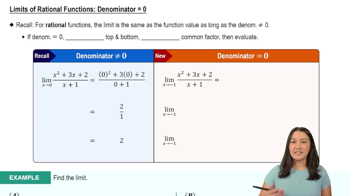
Limits of Rational Functions: Denominator = 0

Limit Laws

Limit laws are a set of rules that allow us to manipulate limits algebraically. These include properties such as the sum, difference, product, and quotient of limits. In the given problem, these laws are applied to break down the limit of a complex expression into simpler parts, making it easier to evaluate the limit as x approaches 0.
Video consigliato:
05:50
One-Sided Limits

Continuity and Non-zero Denominator

For a limit to be evaluated using the quotient rule, the denominator must be non-zero at the point of interest. Continuity ensures that the function behaves predictably around that point. In this problem, it is assumed that the denominator (f(x) + 7)² does not approach zero as x approaches 0, allowing the application of limit laws without encountering undefined behavior.
Video consigliato:
05:34
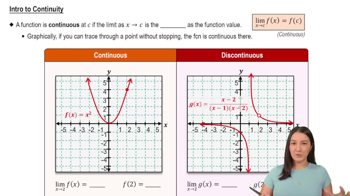
Intro to Continuity