
Ch. 3 - Derivatives
Hass - Thomas' Calculus 15th Edition
Hass15th EditionThomas' CalculusISBN: 9780137616077Non è quello che usi tu?Cambia libro di testo
Capitolo 3, Problema 3.4.34e

Analyzing Motion Using Graphs


[Technology Exercise] Exercises 31–34 give the position function s = f(t) of an object moving along the s-axis as a function of time t. Graph f together with the velocity function v(t) = ds/dt = f'(t) and the acceleration function a(t) = d²s/dt² = f''(t). Comment on the object’s behavior in relation to the signs and values of v and a. Include in your commentary such topics as the following:


e. When is it moving fastest (highest speed)? Slowest?


s = 4 - 7t + 6t² - t³, 0 ≤ t ≤ 4

Guida verificata passo dopo passo
1
Step 1: Begin by identifying the position function given in the problem, which is s(t) = 4 - 7t + 6t² - t³. This function describes the position of the object along the s-axis as a function of time t.
Step 2: To find the velocity function v(t), calculate the first derivative of the position function s(t) with respect to time t. This derivative, v(t) = ds/dt = f'(t), represents the rate of change of position, or how fast the object is moving.
Step 3: Next, determine the acceleration function a(t) by taking the derivative of the velocity function v(t). This second derivative, a(t) = d²s/dt² = f''(t), indicates the rate of change of velocity, or how the speed of the object is changing over time.
Step 4: Graph the position function s(t), the velocity function v(t), and the acceleration function a(t) over the interval 0 ≤ t ≤ 4. This visual representation will help in analyzing the behavior of the object.
Step 5: Analyze the graphs to comment on the object's behavior. Look for points where the velocity v(t) is zero, which indicates a change in direction or a momentary stop. The object moves fastest when the magnitude of v(t) is at its maximum. The acceleration a(t) will provide insights into whether the object is speeding up or slowing down. Consider the signs and values of v(t) and a(t) to determine when the object is moving fastest and slowest.

Risposta video verificata per un problema simile:

Questa soluzione video è stata consigliata dai nostri tutor come utile per risolvere questo problema.
Durata del video:
3m

Concetti chiave

Ecco i concetti essenziali che devi comprendere per rispondere correttamente alla domanda.

Position, Velocity, and Acceleration

In calculus, the position function s(t) describes the location of an object over time. The velocity function v(t) is the first derivative of the position function, representing the rate of change of position, or speed and direction. Acceleration a(t) is the second derivative of the position function, indicating the rate of change of velocity. Understanding these relationships is crucial for analyzing motion.
Video consigliato:
Percorso guidato
08:14
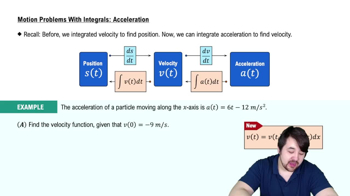
Using The Acceleration Function

Graphical Analysis of Derivatives

Graphing the position, velocity, and acceleration functions helps visualize an object's motion. The velocity graph shows where the object is moving fastest or slowest, indicated by the peaks and troughs. The acceleration graph reveals changes in velocity, with positive values indicating speeding up and negative values indicating slowing down. Analyzing these graphs provides insights into the object's behavior over time.
Video consigliato:
01:47
Graphical Applications of Exponential & Logarithmic Derivatives: Example 8

Critical Points and Inflection Points

Critical points occur where the derivative (velocity) is zero or undefined, indicating potential maximum or minimum speeds. Inflection points occur where the second derivative (acceleration) changes sign, indicating a change in the concavity of the position graph. Identifying these points helps determine when the object is moving fastest or slowest and provides a deeper understanding of its motion dynamics.
Video consigliato:
04:50
Critical Points
Pratica correlata
Domanda del libro di testo

Suppose that functions ƒ(x) and g(x) and their first derivatives have the following values at x = 0 and x = 1.


x ƒ(x) g(x) ƒ'(x) g'(x)

0 1 1 -3 1/2

1 3 5 1/2 -4


Find the first derivatives of the following combinations at the given value of x.


d. ƒ(g(x)), x = 0

378
views
Domanda del libro di testo

Suppose that functions f and g and their derivatives with respect to x have the following values at x = 2 and x = 3.


" style="" width="250">


Find the derivatives with respect to x of the following combinations at the given value of x.


f. √f(x), x = 2

286
views
Domanda del libro di testo

Suppose that the functions f and g and their derivatives with respect to x have the following values at x = 0 and x = 1.


" style="max-width: 100%; white-space-collapse: preserve;" width="250">


Find the derivatives with respect to x of the following combinations at the given value of x.


f. (x¹¹ + f(x))⁻², x = 1

221
views
Domanda del libro di testo

Theory and Examples


In Exercises 51–54,


d. Over what intervals of x-values, if any, does the function y = f(x) increase as x increases? Decrease as x increases? How is this related to what you found in part (c)? (We will say more about this relationship in Section 4.3.)


y = −1/x

180
views
Domanda del libro di testo

Average single-family home prices P (in thousands of dollars) in Sacramento, California, are shown in the accompanying figure from the beginning of 2006 through the end of 2015.


d. During what year did home prices drop most rapidly and what is an estimate of this rate?

161
views
Domanda del libro di testo

Lunar projectile motion A rock thrown vertically upward from the surface of the moon at a velocity of 24 m/sec (about 86 km/h) reaches a height of s = 24t − 0.8t² m in t sec.

e. How long is the rock aloft?

296
views