Ch. 3 - Derivatives
Hass - Thomas' Calculus 15th Edition
Hass15th EditionThomas' CalculusISBN: 9780137616077Non è quello che usi tu?Cambia libro di testo
Capitolo 3, Problema 3.4.32c

Analyzing Motion Using Graphs


[Technology Exercise] Exercises 31–34 give the position function s = f(t) of an object moving along the s-axis as a function of time t. Graph f together with the velocity function v(t) = ds/dt = f'(t) and the acceleration function a(t) = d²s/dt² = f''(t). Comment on the object’s behavior in relation to the signs and values of v and a. Include in your commentary such topics as the following:


c. When does it change direction?


s = t² - 3t + 2, 0 ≤ t ≤ 5

Guida verificata passo dopo passo
1
Step 1: Identify the position function s(t) = t² - 3t + 2. This function describes the position of the object along the s-axis over time.
Step 2: Find the velocity function v(t) by differentiating the position function s(t) with respect to time t. This gives v(t) = ds/dt = f'(t) = 2t - 3.
Step 3: Determine the acceleration function a(t) by differentiating the velocity function v(t) with respect to time t. This results in a(t) = dv/dt = f''(t) = 2.
Step 4: Analyze when the object changes direction by finding when the velocity function v(t) = 0. Solve the equation 2t - 3 = 0 to find the critical points.
Step 5: Comment on the object's behavior: The object changes direction at the time when v(t) = 0. Since the acceleration a(t) = 2 is constant and positive, it indicates that the object is accelerating in the positive direction throughout the interval 0 ≤ t ≤ 5.

Risposta video verificata per un problema simile:

Questa soluzione video è stata consigliata dai nostri tutor come utile per risolvere questo problema.
Durata del video:
2m

Concetti chiave

Ecco i concetti essenziali che devi comprendere per rispondere correttamente alla domanda.

Position, Velocity, and Acceleration

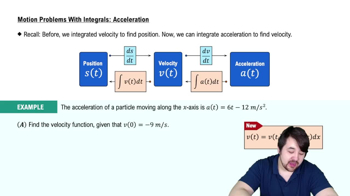
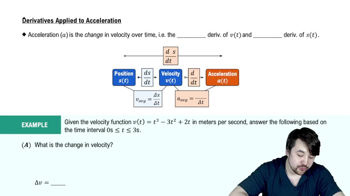
In calculus, the position function s(t) describes the location of an object over time. The velocity function v(t) is the first derivative of the position function, representing the rate of change of position, or speed and direction. Acceleration a(t) is the second derivative of the position function, indicating the rate of change of velocity. Understanding these relationships is crucial for analyzing motion.
Video consigliato:
Percorso guidato
08:14
Using The Acceleration Function

Derivatives and Their Interpretation

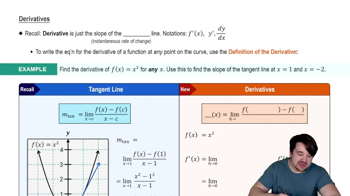
The derivative of a function at a point gives the slope of the tangent line to the function at that point, representing the rate of change. For motion, the first derivative of the position function gives velocity, and the second derivative gives acceleration. Analyzing these derivatives helps determine when an object speeds up, slows down, or changes direction.
Video consigliato:

Sign Analysis of Velocity and Acceleration

The signs of velocity and acceleration provide insights into an object's motion. A positive velocity indicates forward motion, while a negative velocity indicates backward motion. When velocity changes sign, the object changes direction. Acceleration's sign shows whether the object is speeding up or slowing down; positive acceleration increases velocity, while negative acceleration decreases it.
Video consigliato:
Percorso guidato
06:15
Derivatives Applied To Acceleration