Ch. 3 - Derivatives
Hass - Thomas' Calculus 15th Edition
Hass15th EditionThomas' CalculusISBN: 9780137616077Non è quello che usi tu?Cambia libro di testo
Capitolo 3, Problema 56b

Assume that a particle’s position on the x-axis is given by


x = 3 cos t + 4 sin t,


where x is measured in feet and t is measured in seconds.


b. Find the particle’s velocity when t = 0, t = π/2, and t = π.

Guida verificata passo dopo passo
1
To find the particle's velocity, we need to determine the derivative of the position function x(t) with respect to time t. The position function is given as x(t) = 3 cos(t) + 4 sin(t).
Differentiate x(t) with respect to t. The derivative of cos(t) is -sin(t), and the derivative of sin(t) is cos(t). Therefore, the derivative of x(t) is v(t) = -3 sin(t) + 4 cos(t).
Now, substitute t = 0 into the velocity function v(t) = -3 sin(t) + 4 cos(t) to find the velocity at t = 0.
Next, substitute t = π/2 into the velocity function v(t) = -3 sin(t) + 4 cos(t) to find the velocity at t = π/2.
Finally, substitute t = π into the velocity function v(t) = -3 sin(t) + 4 cos(t) to find the velocity at t = π.

Risposta video verificata per un problema simile:

Questa soluzione video è stata consigliata dai nostri tutor come utile per risolvere questo problema.
Durata del video:
2m

Concetti chiave

Ecco i concetti essenziali che devi comprendere per rispondere correttamente alla domanda.

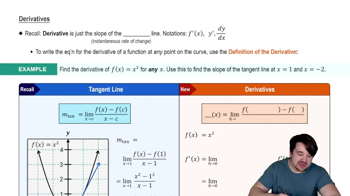
Derivative

The derivative of a function represents the rate of change of the function with respect to a variable. In this context, the derivative of the position function x(t) with respect to time t gives the velocity of the particle. Calculating the derivative allows us to determine how the position changes over time, which is essential for finding the velocity at specific time points.
Video consigliato:

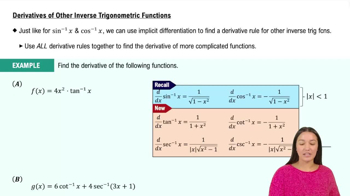
Trigonometric Derivatives

Understanding the derivatives of trigonometric functions is crucial here, as the position function involves sine and cosine. The derivative of cos(t) is -sin(t), and the derivative of sin(t) is cos(t). Applying these rules to the position function x = 3 cos t + 4 sin t helps us find the velocity function, which is necessary to evaluate the velocity at given times.
Video consigliato:
06:35
Derivatives of Other Inverse Trigonometric Functions

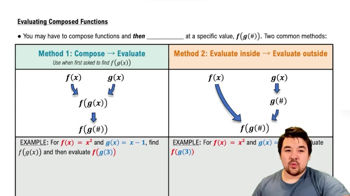
Evaluating Functions at Specific Points

Once the velocity function is derived, it must be evaluated at specific time points: t = 0, t = π/2, and t = π. This involves substituting these values into the velocity function to find the particle's velocity at these moments. This step is crucial for understanding the particle's motion at different times and requires careful substitution and simplification.
Video consigliato:
Percorso guidato
4:26
Evaluating Composed Functions