Find all points on the curve y = tan x, −π/2 < x < π/2, where the tangent line is parallel to the line y = 2x. Sketch the curve and tangent lines together, labeling each with its equation.
Ch. 3 - Derivatives
Capitolo 3, Problema 3.3.6
Derivative Calculations
In Exercises 1–12, find the first and second derivatives.
y = x³/3 + x²/2 + x/4
Guida verificata passo dopo passo1
Step 1: Identify the function for which you need to find the derivatives. The given function is \( y = \frac{x^3}{3} + \frac{x^2}{2} + \frac{x}{4} \).
Step 2: To find the first derivative, apply the power rule to each term of the function. The power rule states that the derivative of \( x^n \) is \( nx^{n-1} \).
Step 3: Differentiate each term separately: \( \frac{d}{dx} \left( \frac{x^3}{3} \right) = x^2 \), \( \frac{d}{dx} \left( \frac{x^2}{2} \right) = x \), and \( \frac{d}{dx} \left( \frac{x}{4} \right) = \frac{1}{4} \). Combine these results to get the first derivative.
Step 4: To find the second derivative, differentiate the first derivative. Apply the power rule again to each term of the first derivative.
Step 5: Differentiate each term of the first derivative: \( \frac{d}{dx} (x^2) = 2x \), \( \frac{d}{dx} (x) = 1 \), and \( \frac{d}{dx} \left( \frac{1}{4} \right) = 0 \). Combine these results to get the second derivative.

Risposta video verificata per un problema simile:
Questa soluzione video è stata consigliata dai nostri tutor come utile per risolvere questo problema.
Durata del video:
2mConcetti chiave
Ecco i concetti essenziali che devi comprendere per rispondere correttamente alla domanda.
Power Rule for Derivatives
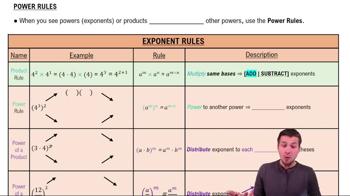
The power rule is a basic principle in calculus used to find the derivative of a function of the form f(x) = x^n. The rule states that the derivative, f'(x), is n*x^(n-1). This rule simplifies the process of differentiation, allowing us to easily find the rate of change of polynomial functions.
Video consigliato:
Power Rules
Sum Rule for Derivatives
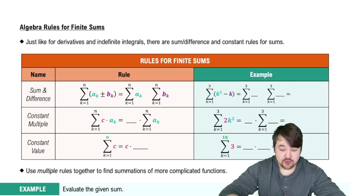
The sum rule for derivatives states that the derivative of a sum of functions is the sum of their derivatives. If you have a function y = f(x) + g(x), the derivative y' is f'(x) + g'(x). This rule allows us to differentiate each term in a polynomial separately and then combine the results.
Video consigliato:
Percorso guidato
Algebra Rules for Finite Sums
Second Derivative
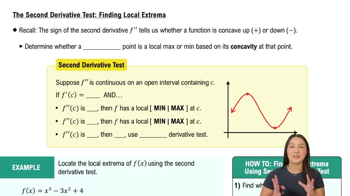
The second derivative of a function is the derivative of the first derivative, providing information about the curvature or concavity of the original function. It is denoted as f''(x) or d²y/dx². Calculating the second derivative helps in understanding the acceleration or the rate of change of the rate of change of the function.
Video consigliato:
The Second Derivative Test: Finding Local Extrema
Pratica correlata
Domanda del libro di testo
255
views
Domanda del libro di testo
Derivatives in Differential Form
In Exercises 17–28, find dy.
y = cos(x²)
173
views
Domanda del libro di testo
Derivative of multiples Does knowing that a function g(t) is differentiable at t = 7 tell you anything about the differentiability of the function 3g at t = 7? Give reasons for your answer.
172
views
Domanda del libro di testo
In Exercises 41–44, determine whether the piecewise-defined function is differentiable at x = 0.
g(x) = { 2x − x³ − 1, x ≥ 0
x − (1 / (x + 1)), x < 0
306
views
Domanda del libro di testo
In Exercises 5–10, find an equation for the tangent line to the curve at the given point. Then sketch the curve and tangent line together.
y = (1 / x²), (−1, 1)
209
views
Domanda del libro di testo
Slopes and Tangent Lines
In Exercises 1–4, use the grid and a straight edge to make a rough estimate of the slope of the curve (in y-units per x-unit) at the points P₁ and P₂.
256
views