

Ch. 3 - Derivatives
Hass - Thomas' Calculus 15th Edition
Hass15th EditionThomas' CalculusISBN: 9780137616077Non è quello che usi tu?Cambia libro di testo
Capitolo 3, Problema 3.9.27

Derivatives in Differential Form


In Exercises 17–28, find dy.


y = 3 csc(1 − 2√x)

Guida verificata passo dopo passo
1
Step 1: Identify the function y = 3 csc(1 - 2√x). The goal is to find dy, which involves differentiating y with respect to x.
Step 2: Recognize that the function involves a composite function: y = 3 csc(u), where u = 1 - 2√x. Use the chain rule for differentiation, which states that dy/dx = dy/du * du/dx.
Step 3: Differentiate the outer function with respect to u. The derivative of csc(u) with respect to u is -csc(u)cot(u). Therefore, dy/du = 3 * (-csc(u)cot(u)).
Step 4: Differentiate the inner function u = 1 - 2√x with respect to x. The derivative of √x is 1/(2√x), so du/dx = -2 * (1/(2√x)) = -1/√x.
Step 5: Combine the derivatives using the chain rule: dy/dx = dy/du * du/dx = 3 * (-csc(u)cot(u)) * (-1/√x). Substitute u = 1 - 2√x back into the expression to complete the differentiation.

Risposta video verificata per un problema simile:

Questa soluzione video è stata consigliata dai nostri tutor come utile per risolvere questo problema.
Durata del video:
3m

Concetti chiave

Ecco i concetti essenziali che devi comprendere per rispondere correttamente alla domanda.

Derivative of Trigonometric Functions

Understanding the derivatives of trigonometric functions is crucial. The derivative of csc(x) is -csc(x)cot(x). This knowledge helps in differentiating expressions involving trigonometric functions, such as y = 3 csc(1 - 2√x), by applying the chain rule to account for the inner function.
Video consigliato:
Percorso guidato
6:04
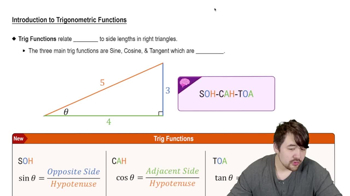
Introduction to Trigonometric Functions

Chain Rule

The chain rule is essential for differentiating composite functions. It states that the derivative of a composite function f(g(x)) is f'(g(x))g'(x). In the given problem, the chain rule helps differentiate the inner function 1 - 2√x, which is part of the composite trigonometric function.
Video consigliato:
05:02
Intro to the Chain Rule

Differentiation of Radical Functions

Differentiating functions involving radicals, such as √x, requires understanding their derivatives. The derivative of √x is (1/2)x^(-1/2). This concept is necessary to find the derivative of the inner function 1 - 2√x, which is part of the overall differentiation process in the given problem.
Video consigliato:
Percorso guidato
05:53
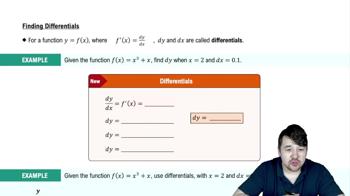
Finding Differentials