Find an equation of the straight line having slope 1/4 that is tangent to the curve y = √x.
Ch. 3 - Derivatives
Capitolo 3, Problema 3.6.78
Find dy/dt when x = 1 if y = x² + 7x − 5 and dx/dt = ¹/₃.
Guida verificata passo dopo passo1
First, identify the given function y = x² + 7x − 5. This is the function for which we need to find the derivative with respect to time, t.
To find dy/dt, use the chain rule. The chain rule states that dy/dt = (dy/dx) * (dx/dt). We need to find dy/dx first.
Differentiate y = x² + 7x − 5 with respect to x to find dy/dx. The derivative of x² is 2x, and the derivative of 7x is 7. Therefore, dy/dx = 2x + 7.
Substitute x = 1 into the expression for dy/dx to find the specific value of the derivative at x = 1. This gives dy/dx = 2(1) + 7.
Now, substitute dy/dx and dx/dt = ¹/₃ into the chain rule formula: dy/dt = (dy/dx) * (dx/dt). Calculate dy/dt using the values obtained in the previous steps.

Risposta video verificata per un problema simile:
Questa soluzione video è stata consigliata dai nostri tutor come utile per risolvere questo problema.
Durata del video:
2mConcetti chiave
Ecco i concetti essenziali che devi comprendere per rispondere correttamente alla domanda.
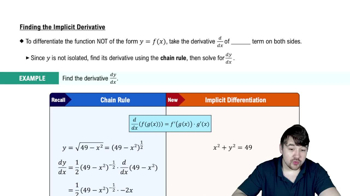
Implicit Differentiation
Implicit differentiation is a technique used to find the derivative of a function when it is not explicitly solved for one variable in terms of another. In this context, it helps us differentiate y with respect to t by considering the relationship between x and y, and using the chain rule to account for dx/dt.
Video consigliato:
Percorso guidato
Finding The Implicit Derivative
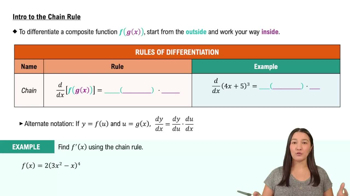
Chain Rule
The chain rule is a fundamental concept in calculus used to differentiate composite functions. It states that the derivative of a composite function is the derivative of the outer function evaluated at the inner function times the derivative of the inner function. Here, it allows us to find dy/dt by multiplying dy/dx by dx/dt.
Video consigliato:
Intro to the Chain Rule
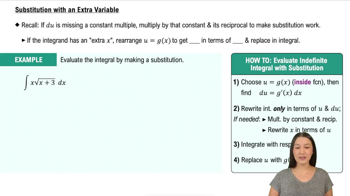
Substitution
Substitution involves replacing variables with known values to simplify expressions or solve equations. In this problem, after finding the expression for dy/dt, we substitute x = 1 and dx/dt = 1/3 to calculate the specific value of dy/dt at that point, providing a concrete solution to the problem.
Video consigliato:
Substitution With an Extra Variable
Pratica correlata
Domanda del libro di testo
225
views
Domanda del libro di testo
Theory and Examples
Intersecting normal line The line that is normal to the curve x² + 2xy – 3y² = 0 at (1,1) intersects the curve at what other point?
340
views
Domanda del libro di testo
In Exercises 41–58, find dy/dt.
y = √(3t + (√2 + √(1 − t)))
288
views
Domanda del libro di testo
Are there any points on the curve y = x - 1/(2x) where the slope is 2? If so, find them.
212
views
Domanda del libro di testo
A growing sand pile Sand falls from a conveyor belt at the rate of 10 m³/min onto the top of a conical pile. The height of the pile is always three-eighths of the base diameter. How fast are the (a) height and (b) radius changing when the pile is 4 m high? Answer in centimeters per minute.
303
views
Domanda del libro di testo
If r + s² + v³ = 12, dr/dt = 4, and ds/dt = –3, find dv/dt when r = 3 and s = 1.
187
views