Ch. 3 - Derivatives
Hass - Thomas' Calculus 15th Edition
Hass15th EditionThomas' CalculusISBN: 9780137616077Non è quello che usi tu?Cambia libro di testo
Capitolo 3, Problema 3.6.33

Find the derivatives of the functions in Exercises 19–40.


f(x) = √(7 + x sec x)

Guida verificata passo dopo passo
1
Identify the function: f(x) = √(7 + x sec x). This is a composite function, where the outer function is a square root and the inner function is 7 + x sec x.
Apply the chain rule for differentiation. The chain rule states that if you have a composite function f(g(x)), the derivative is f'(g(x)) * g'(x).
Differentiate the outer function with respect to its inner function. The derivative of √u with respect to u is (1/2)u^(-1/2). So, for √(7 + x sec x), the derivative is (1/2)(7 + x sec x)^(-1/2).
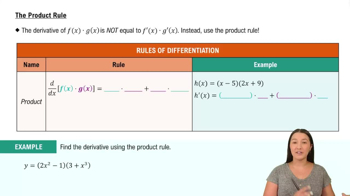
Differentiate the inner function 7 + x sec x with respect to x. The derivative of 7 is 0, and the derivative of x sec x requires the product rule. The product rule states that the derivative of u(x)v(x) is u'(x)v(x) + u(x)v'(x). Here, u(x) = x and v(x) = sec x, so u'(x) = 1 and v'(x) = sec x tan x.
Combine the results from the previous steps. Multiply the derivative of the outer function by the derivative of the inner function: (1/2)(7 + x sec x)^(-1/2) * (0 + sec x + x sec x tan x). Simplify the expression to obtain the final derivative.

Risposta video verificata per un problema simile:

Questa soluzione video è stata consigliata dai nostri tutor come utile per risolvere questo problema.
Durata del video:
5m

Concetti chiave

Ecco i concetti essenziali che devi comprendere per rispondere correttamente alla domanda.

Derivative

The derivative of a function measures how the function's output changes as its input changes. It is a fundamental concept in calculus, representing the rate of change or slope of the function at any given point. Calculating derivatives involves applying rules such as the power rule, product rule, and chain rule to find the instantaneous rate of change.
Video consigliato:

Chain Rule

The chain rule is a formula for computing the derivative of the composition of two or more functions. It is essential when dealing with functions nested within other functions, such as f(x) = √(7 + x sec x). The chain rule states that the derivative of a composite function is the derivative of the outer function evaluated at the inner function times the derivative of the inner function.
Video consigliato:
05:02
Intro to the Chain Rule

Product Rule

The product rule is used to find the derivative of the product of two functions. If you have a function that is the product of two functions, such as x sec x, the product rule states that the derivative is the first function times the derivative of the second plus the second function times the derivative of the first. This rule is crucial for differentiating expressions where multiplication of functions is involved.
Video consigliato:
05:18
The Product Rule