Ch. 3 - Derivatives
Hass - Thomas' Calculus 15th Edition
Hass15th EditionThomas' CalculusISBN: 9780137616077Non è quello che usi tu?Cambia libro di testo
Capitolo 3, Problema 3.6.21

Find the derivatives of the functions in Exercises 19–40.


s = (4 / 3π)sin(3t) + (4 / 5π)cos(5t)

Guida verificata passo dopo passo
1
Identify the function components: The function s(t) is composed of two trigonometric terms: (4 / 3π)sin(3t) and (4 / 5π)cos(5t). Each term will be differentiated separately.
Apply the derivative rule for sine: The derivative of sin(kt) with respect to t is k * cos(kt). For the term (4 / 3π)sin(3t), apply this rule to find its derivative.
Differentiate the first term: The derivative of (4 / 3π)sin(3t) is (4 / 3π) * 3 * cos(3t). Simplify this expression to get the derivative of the first term.
Apply the derivative rule for cosine: The derivative of cos(kt) with respect to t is -k * sin(kt). For the term (4 / 5π)cos(5t), apply this rule to find its derivative.
Differentiate the second term: The derivative of (4 / 5π)cos(5t) is -(4 / 5π) * 5 * sin(5t). Simplify this expression to get the derivative of the second term.

Risposta video verificata per un problema simile:

Questa soluzione video è stata consigliata dai nostri tutor come utile per risolvere questo problema.
Durata del video:
2m

Concetti chiave

Ecco i concetti essenziali che devi comprendere per rispondere correttamente alla domanda.

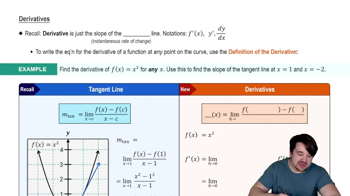
Derivative

The derivative of a function measures how the function's output value changes as its input value changes. It is defined as the limit of the average rate of change of the function over an interval as the interval approaches zero. In calculus, the derivative is often denoted as f'(x) or dy/dx, and it provides critical information about the function's behavior, such as its slope and concavity.
Video consigliato:

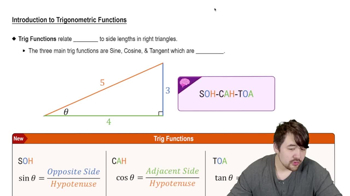
Trigonometric Functions

Trigonometric functions, such as sine and cosine, are fundamental in calculus and describe relationships between angles and sides of triangles. They are periodic functions, meaning they repeat their values in regular intervals. Understanding their derivatives is essential, as they follow specific rules: the derivative of sin(x) is cos(x), and the derivative of cos(x) is -sin(x), which are crucial for differentiating functions involving these terms.
Video consigliato:
Percorso guidato
6:04
Introduction to Trigonometric Functions

Chain Rule

The chain rule is a fundamental technique in calculus used to differentiate composite functions. It states that if a function y = f(g(x)) is composed of two functions, the derivative can be found by multiplying the derivative of the outer function f with the derivative of the inner function g. This rule is particularly useful when dealing with trigonometric functions that are themselves functions of another variable, such as t in the given expression.
Video consigliato:
05:02
Intro to the Chain Rule