Ch. 3 - Derivatives
Hass - Thomas' Calculus 15th Edition
Hass15th EditionThomas' CalculusISBN: 9780137616077Non è quello che usi tu?Cambia libro di testo
Capitolo 3, Problema 1

Finding Derivative Functions and Values 


Using the definition, calculate the derivatives of the functions in Exercises 1–6. Then find the values of the derivatives as specified.


f(x) = 4 – x²; f′(−3), f′(0), f′(1)

Guida verificata passo dopo passo
1
Start by recalling the definition of the derivative: f'(x) = lim(h -> 0) [(f(x + h) - f(x)) / h]. This will be used to find the derivative of the function f(x) = 4 - x².
Substitute f(x) = 4 - x² into the definition: f'(x) = lim(h -> 0) [((4 - (x + h)²) - (4 - x²)) / h].
Simplify the expression inside the limit: (4 - (x + h)²) - (4 - x²) = -((x + h)²) + x². Expand (x + h)² to get x² + 2xh + h².
Continue simplifying: -((x² + 2xh + h²) - x²) = -(2xh + h²). The expression becomes: f'(x) = lim(h -> 0) [(-2xh - h²) / h].
Factor out h from the numerator: f'(x) = lim(h -> 0) [-h(2x + h) / h]. Cancel h from numerator and denominator, then evaluate the limit as h approaches 0 to find f'(x) = -2x. Finally, substitute x = -3, 0, and 1 into f'(x) to find f'(-3), f'(0), and f'(1).

Risposta video verificata per un problema simile:

Questa soluzione video è stata consigliata dai nostri tutor come utile per risolvere questo problema.
Durata del video:
3m

Concetti chiave

Ecco i concetti essenziali che devi comprendere per rispondere correttamente alla domanda.

Definition of Derivative

The derivative of a function at a point is the limit of the average rate of change of the function as the interval approaches zero. Mathematically, it is defined as f'(x) = lim(h→0) [(f(x+h) - f(x))/h]. This concept is essential for understanding how to calculate the instantaneous rate of change of a function.
Video consigliato:
Percorso guidato
05:43
Definition of the Definite Integral

Power Rule for Derivatives

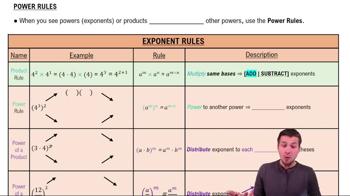
The power rule is a basic derivative rule used to find the derivative of functions in the form of x^n. It states that if f(x) = x^n, then f'(x) = n*x^(n-1). This rule simplifies the process of finding derivatives for polynomial functions, such as f(x) = 4 - x², where the derivative is calculated using this rule.
Video consigliato:
5:50
Power Rules

Evaluating Derivatives at Specific Points

Once the derivative function is found, it can be evaluated at specific points to find the slope of the tangent line at those points. For example, after finding f'(x) for f(x) = 4 - x², you can substitute x = -3, 0, and 1 into f'(x) to find f'(-3), f'(0), and f'(1), respectively, which represent the instantaneous rate of change at these points.
Video consigliato:
04:50
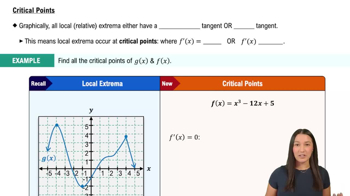
Critical Points