Ch. 3 - Derivatives
Hass - Thomas' Calculus 15th Edition
Hass15th EditionThomas' CalculusISBN: 9780137616077Non è quello che usi tu?Cambia libro di testo
Capitolo 3, Problema 3.6.68

Finding Derivative Values


In Exercises 67–72, find the value of (f ∘ g)' at the given value of x.


f(u) = 1 − (1/u), u = g(x) = (1 / (1 − x)), x = −1

Guida verificata passo dopo passo
1
First, understand that you need to find the derivative of the composition of two functions, (f ∘ g)(x), which is f(g(x)).
Identify the functions involved: f(u) = 1 - (1/u) and g(x) = 1 / (1 - x).
Apply the chain rule for derivatives, which states that the derivative of a composition of functions (f ∘ g)'(x) is f'(g(x)) * g'(x).
Calculate g'(x) by differentiating g(x) = 1 / (1 - x). Use the quotient rule or recognize it as a power function to find g'(x).
Calculate f'(u) by differentiating f(u) = 1 - (1/u). Use the power rule to find f'(u). Then evaluate f'(g(x)) at x = -1 using the values obtained from the previous steps.

Risposta video verificata per un problema simile:

Questa soluzione video è stata consigliata dai nostri tutor come utile per risolvere questo problema.
Durata del video:
5m

Concetti chiave

Ecco i concetti essenziali che devi comprendere per rispondere correttamente alla domanda.

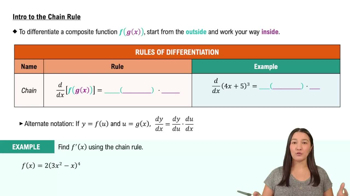
Chain Rule

The Chain Rule is a fundamental theorem in calculus used to differentiate composite functions. It states that if you have a function f(g(x)), the derivative can be found by multiplying the derivative of the outer function f with the derivative of the inner function g. This rule is essential for finding the derivative of functions where one function is nested within another.
Video consigliato:
05:02
Intro to the Chain Rule

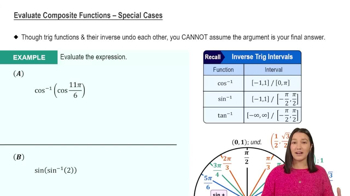
Composite Functions

A composite function is formed when one function is applied to the result of another function, denoted as f(g(x)). Understanding how to work with composite functions is crucial for applying the Chain Rule effectively. In this problem, f(u) and g(x) are composite, where g(x) serves as the input for f.
Video consigliato:
3:48
Evaluate Composite Functions - Special Cases

Evaluating Derivatives

Evaluating derivatives involves calculating the slope of a function at a specific point. In this context, after applying the Chain Rule, you will need to substitute the given value of x into the derivative expression to find the specific value of (f ∘ g)' at that point. This step is critical for obtaining the final answer.
Video consigliato:
5:14
Evaluate Logarithms