Ch. 3 - Derivatives
Hass - Thomas' Calculus 15th Edition
Hass15th EditionThomas' CalculusISBN: 9780137616077Non è quello che usi tu?Cambia libro di testo
Capitolo 3, Problema 3.3.63b

Generalizing the Product Rule The Derivative Product Rule gives the formula


d/dx (uv) = u (dv/dx) + (du/dx) v


for the derivative of the product uv of two differentiable functions of x.


b. What is the formula for the derivative of the product u₁u₂u₃u₄ of four differentiable functions of x?

Guida verificata passo dopo passo
1
To find the derivative of the product of four functions, u₁u₂u₃u₄, we can extend the product rule. The product rule for two functions states that the derivative of a product uv is given by d/dx (uv) = u (dv/dx) + (du/dx) v.
For four functions, we apply the product rule iteratively. First, consider the product of the first two functions, u₁u₂, and the product of the last two functions, u₃u₄. We can treat these as two separate products and apply the product rule to each.
The derivative of u₁u₂u₃u₄ can be expressed as: d/dx (u₁u₂u₃u₄) = (d/dx (u₁u₂)) u₃u₄ + u₁u₂ (d/dx (u₃u₄)).
Now, apply the product rule to each part: d/dx (u₁u₂) = u₁ (du₂/dx) + (du₁/dx) u₂ and d/dx (u₃u₄) = u₃ (du₄/dx) + (du₃/dx) u₄.
Substitute these derivatives back into the expression: d/dx (u₁u₂u₃u₄) = [u₁ (du₂/dx) + (du₁/dx) u₂] u₃u₄ + u₁u₂ [u₃ (du₄/dx) + (du₃/dx) u₄].

Risposta video verificata per un problema simile:

Questa soluzione video è stata consigliata dai nostri tutor come utile per risolvere questo problema.
Durata del video:
4m

Concetti chiave

Ecco i concetti essenziali che devi comprendere per rispondere correttamente alla domanda.

Product Rule

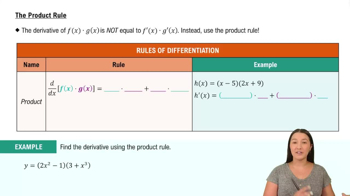
The Product Rule is a fundamental theorem in calculus that provides a method for differentiating the product of two functions. It states that the derivative of the product of two functions u and v is given by d/dx(uv) = u(dv/dx) + v(du/dx). This rule can be extended to more than two functions, which is essential for solving problems involving multiple products.
Video consigliato:
05:18
The Product Rule

Higher-Order Product Rule

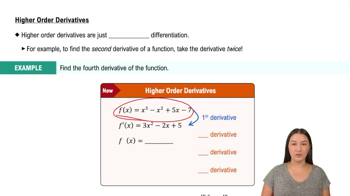
The Higher-Order Product Rule generalizes the Product Rule to the differentiation of products involving more than two functions. For three functions, the derivative can be expressed as d/dx(u₁u₂u₃) = u₁(u₂' u₃ + u₂ u₃') + u₂(u₁' u₃ + u₁ u₃') + u₃(u₁' u₂ + u₁ u₂'). This pattern continues, allowing for systematic differentiation of products of any number of functions.
Video consigliato:
02:42
Higher Order Derivatives

Differentiability

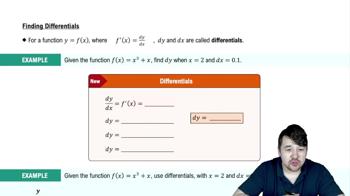
Differentiability is a key concept in calculus that indicates whether a function has a derivative at a given point. A function is differentiable at a point if it is continuous there and its derivative exists. This property is crucial when applying the Product Rule, as it ensures that the functions involved can be differentiated, allowing for the application of the rule to find the derivative of their product.
Video consigliato:
Percorso guidato
05:53
Finding Differentials
Pratica correlata
Domanda del libro di testo

Consider the function


f(x) = { x² cos(2/x), x ≠ 0

0, x = 0


b. Determine f' for x ≠ 0.

188
views

Domanda del libro di testo

Temperatures in Fairbanks, Alaska The graph in the accompanying figure shows the average Fahrenheit temperature in Fairbanks, Alaska, during a typical 365-day year. The equation that approximates the temperature on day x is


y = 37 sin[(2π/365)(x − 101)] + 25


and is graphed in the accompanying figure.


b. About how many degrees per day is the temperature increasing when it is increasing at its fastest?


" style="max-width: 100%; white-space-collapse: preserve;" width="420">

246
views
Domanda del libro di testo

Right circular cylinder The total surface area S of a right circular cylinder is related to the base radius r and height h by the equation S = 2πr² + 2πrh.


b. How is dS/dt related to dh/dt if r is constant?

244
views
Domanda del libro di testo

Computer Explorations


Use a CAS to perform the following steps in Exercises 55–62.


b. Using implicit differentiation, find a formula for the derivative dy/dx and evaluate it at the given point P.


x√(1 + 2y) + y = x², P(1,0)

187
views
Domanda del libro di testo

Diagonals If x, y, and z are lengths of the edges of a rectangular box, then the common length of the box’s diagonals is s = √(x² + y² + z²).

b. How is ds/dt related to dy/dt and dz/dt if x is constant?

198
views
Domanda del libro di testo

b. Show that


f(x) = { x² sin(1/x), x ≠ 0

0, x = 0

is differentiable at x = 0 and find f′(0).

231
views