If x = y³ – y and dy/dt = 5, then what is dx/dt when y = 2?
Ch. 3 - Derivatives
Capitolo 3, Problema 3.6.51
In Exercises 41–58, find dy/dt.
y = (1 + tan⁴(t/12))³
Guida verificata passo dopo passo1
Identify the function y = (1 + tan⁴(t/12))³ and recognize that you need to find the derivative dy/dt using the chain rule.
Apply the chain rule: If y = u³, then dy/dt = 3u² * du/dt. Here, u = 1 + tan⁴(t/12).
Find du/dt by differentiating u = 1 + tan⁴(t/12) with respect to t. Use the chain rule again: If u = 1 + v⁴, where v = tan(t/12), then du/dt = 4v³ * dv/dt.
Differentiate v = tan(t/12) with respect to t. Use the chain rule: If v = tan(w), where w = t/12, then dv/dt = sec²(w) * dw/dt. Since w = t/12, dw/dt = 1/12.
Combine all the derivatives: Substitute dv/dt back into du/dt, and then substitute du/dt into dy/dt to get the final expression for dy/dt.

Risposta video verificata per un problema simile:
Questa soluzione video è stata consigliata dai nostri tutor come utile per risolvere questo problema.
Durata del video:
8mConcetti chiave
Ecco i concetti essenziali che devi comprendere per rispondere correttamente alla domanda.
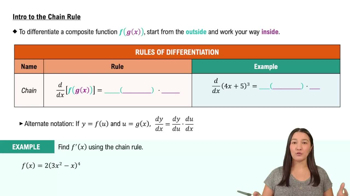
Chain Rule
The chain rule is a fundamental differentiation technique used when dealing with composite functions. It states that the derivative of a composite function is the derivative of the outer function evaluated at the inner function, multiplied by the derivative of the inner function. In this problem, the chain rule helps differentiate y = (1 + tan⁴(t/12))³ by breaking it into manageable parts.
Video consigliato:
Intro to the Chain Rule
Derivative of Trigonometric Functions
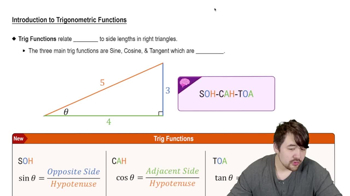
Understanding how to differentiate trigonometric functions is crucial for solving calculus problems involving these functions. The derivative of tan(x) is sec²(x), and this knowledge is essential when differentiating tan⁴(t/12) in the given function. Applying this derivative correctly is key to finding dy/dt.
Video consigliato:
Percorso guidato
Introduction to Trigonometric Functions
Power Rule
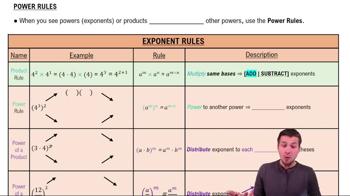
The power rule is a basic differentiation rule used to find the derivative of functions in the form of xⁿ. It states that the derivative of xⁿ is n*xⁿ⁻¹. In this problem, the power rule is applied to differentiate the expression (1 + tan⁴(t/12))³, which involves raising a function to a power, thus requiring the use of the power rule in conjunction with the chain rule.
Video consigliato:
Power Rules
Pratica correlata
Domanda del libro di testo
202
views
Domanda del libro di testo
In Exercises 5–10, find an equation for the tangent line to the curve at the given point. Then sketch the curve and tangent line together.
y = (1 / x³), (−2, −1/8)
271
views
Domanda del libro di testo
Theory and Examples
The equations in Exercises 49 and 50 give the position s = f(t) of a body moving on a coordinate line (s in meters, t in seconds). Find the body’s velocity, speed, acceleration, and jerk at time t = π/4 sec.
s = 2 − 2 sin t
225
views
Domanda del libro di testo
Find the derivatives of the functions in Exercises 1–42.
___
𝓻 = sin √ 2θ
336
views
Domanda del libro di testo
Differentiating Implicitly
Use implicit differentiation to find dy/dx in Exercises 1–14.
xy = cot(xy)
293
views
Domanda del libro di testo
Is there a value of c that will make
f(x) = { (sin²(3x)) / x², x ≠ 0
c, x = 0
continuous at x = 0? Give reasons for your answer.
285
views