Ch. 3 - Derivatives
Hass - Thomas' Calculus 15th Edition
Hass15th EditionThomas' CalculusISBN: 9780137616077Non è quello che usi tu?Cambia libro di testo
Capitolo 3, Problema 3.53

In Exercises 53 and 54, find dr/ds.


r cos 2s + sin²s = π

Guida verificata passo dopo passo
1
Identify the given equation: \( r \cos(2s) + \sin^2(s) = \pi \). We need to find \( \frac{dr}{ds} \).
Differentiate both sides of the equation with respect to \( s \). Use the product rule for \( r \cos(2s) \) and the chain rule for \( \sin^2(s) \).
For the term \( r \cos(2s) \), apply the product rule: \( \frac{d}{ds}(r \cos(2s)) = \frac{dr}{ds} \cos(2s) + r \frac{d}{ds}(\cos(2s)) \).
Differentiate \( \cos(2s) \) using the chain rule: \( \frac{d}{ds}(\cos(2s)) = -2\sin(2s) \).
Differentiate \( \sin^2(s) \) using the chain rule: \( \frac{d}{ds}(\sin^2(s)) = 2\sin(s)\cos(s) \).

Risposta video verificata per un problema simile:

Questa soluzione video è stata consigliata dai nostri tutor come utile per risolvere questo problema.
Durata del video:
5m

Concetti chiave

Ecco i concetti essenziali che devi comprendere per rispondere correttamente alla domanda.

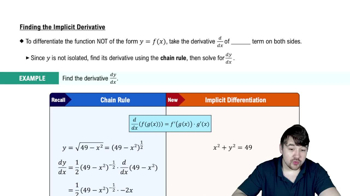
Implicit Differentiation

Implicit differentiation is a technique used to differentiate equations where the dependent and independent variables are not explicitly separated. In this case, we have an equation involving both r and s, and we need to find the derivative dr/ds. By differentiating both sides of the equation with respect to s, we can apply the chain rule to find the relationship between the derivatives.
Video consigliato:
Percorso guidato
05:14
Finding The Implicit Derivative

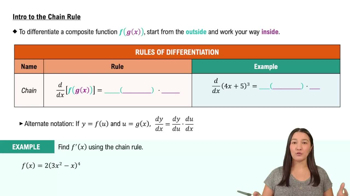
Chain Rule

The chain rule is a fundamental principle in calculus that allows us to differentiate composite functions. When differentiating an expression like r(s), where r is a function of s, the chain rule states that the derivative of r with respect to s is the product of the derivative of r with respect to its argument and the derivative of that argument with respect to s. This is crucial for finding dr/ds in the given equation.
Video consigliato:
05:02
Intro to the Chain Rule

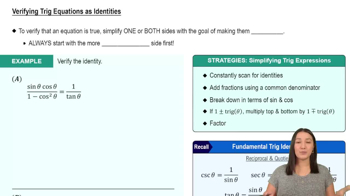
Trigonometric Identities

Trigonometric identities are equations involving trigonometric functions that hold true for all values of the variables. In the given equation, we encounter cos(2s) and sin²(s), which can be simplified using identities such as the double angle formula for cosine and the Pythagorean identity. Understanding these identities is essential for simplifying the equation and effectively finding the derivative.
Video consigliato:
7:17
Verifying Trig Equations as Identities