Ch. 3 - Derivatives
Hass - Thomas' Calculus 15th Edition
Hass15th EditionThomas' CalculusISBN: 9780137616077Non è quello che usi tu?Cambia libro di testo
Capitolo 3, Problema 3.2.39

One-Sided Derivatives


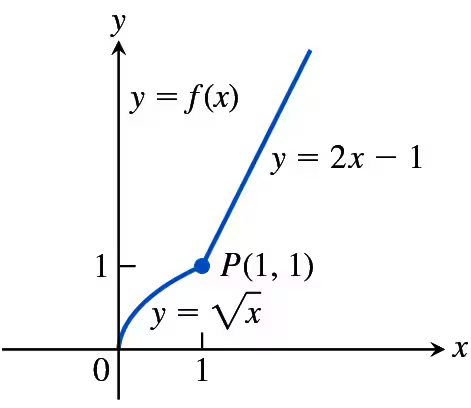
Compute the right-hand and left-hand derivatives as limits to show that the functions in Exercises 37–40 are not differentiable at the point P.
Graph showing a point P(1,1) on the curve y=sqrt(x) and a tangent line y=2x-1, illustrating differentiability concepts.

Guida verificata passo dopo passo
1
Identify the function and the point of interest: The function is piecewise, with \( y = \sqrt{x} \) for \( x < 1 \) and \( y = 2x - 1 \) for \( x \geq 1 \). The point of interest is \( P(1, 1) \).
Compute the left-hand derivative at \( x = 1 \): Use the definition of the derivative as a limit. For \( x < 1 \), the function is \( y = \sqrt{x} \). The left-hand derivative is \( \lim_{{h \to 0^-}} \frac{\sqrt{1+h} - 1}{h} \).
Compute the right-hand derivative at \( x = 1 \): For \( x \geq 1 \), the function is \( y = 2x - 1 \). The right-hand derivative is \( \lim_{{h \to 0^+}} \frac{(2(1+h) - 1) - 1}{h} \).
Evaluate the left-hand limit: Simplify the expression \( \frac{\sqrt{1+h} - 1}{h} \) using algebraic manipulation, such as multiplying by the conjugate, to find the limit as \( h \to 0^- \).
Evaluate the right-hand limit: Simplify the expression \( \frac{2h}{h} \) to find the limit as \( h \to 0^+ \). Compare the left-hand and right-hand derivatives to determine if they are equal.

Risposta video verificata per un problema simile:

Questa soluzione video è stata consigliata dai nostri tutor come utile per risolvere questo problema.
Durata del video:
5m

Concetti chiave

Ecco i concetti essenziali che devi comprendere per rispondere correttamente alla domanda.

One-Sided Derivatives

One-sided derivatives are limits that evaluate the behavior of a function as it approaches a specific point from one side only. The right-hand derivative considers the limit as the input approaches the point from the right, while the left-hand derivative considers the limit from the left. If these two limits exist but are not equal, the function is not differentiable at that point.
Video consigliato:
05:50
One-Sided Limits

Differentiability

A function is differentiable at a point if it has a defined derivative at that point, which means the function must be continuous and have a unique tangent line. If the left-hand and right-hand derivatives at a point are not equal, the function is not differentiable there. This concept is crucial for understanding the smoothness and behavior of functions at specific points.
Video consigliato:
Percorso guidato
05:53
Finding Differentials

Limits

Limits are fundamental in calculus, representing the value that a function approaches as the input approaches a certain point. They are essential for defining derivatives, as the derivative itself is the limit of the average rate of change of the function as the interval shrinks to zero. Understanding limits allows for the analysis of function behavior near points of interest, particularly in determining continuity and differentiability.
Video consigliato:
05:50
One-Sided Limits