Ch. 3 - Derivatives
Hass - Thomas' Calculus 15th Edition
Hass15th EditionThomas' CalculusISBN: 9780137616077Non è quello che usi tu?Cambia libro di testo
Capitolo 3, Problema 3.3.64

Power Rule for negative integers Use the Derivative Quotient Rule to prove the Power Rule for negative integers, that is,
d/dx (x⁻ᵐ) = −mx⁻ᵐ⁻¹
where m is a positive integer.

Guida verificata passo dopo passo
1
Start by expressing the function x^(-m) as a fraction: x^(-m) = 1/x^m.
Apply the Quotient Rule for derivatives, which states that if you have a function in the form of u/v, the derivative is (v * du/dx - u * dv/dx) / v^2.
Set u = 1 and v = x^m. Then, compute the derivatives: du/dx = 0 and dv/dx = m * x^(m-1).
Substitute these into the Quotient Rule formula: (x^m * 0 - 1 * m * x^(m-1)) / (x^m)^2.
Simplify the expression: -m * x^(m-1) / x^(2m) = -m * x^(-m-1), which proves the Power Rule for negative integers.

Risposta video verificata per un problema simile:

Questa soluzione video è stata consigliata dai nostri tutor come utile per risolvere questo problema.
Durata del video:
3m

Concetti chiave

Ecco i concetti essenziali che devi comprendere per rispondere correttamente alla domanda.

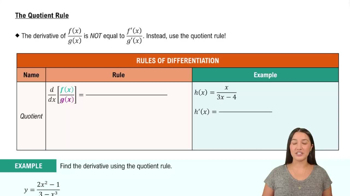
Derivative Quotient Rule

The Quotient Rule is a method for finding the derivative of a function that is the ratio of two differentiable functions. If you have a function f(x) = g(x)/h(x), the derivative f'(x) is given by (g'(x)h(x) - g(x)h'(x)) / (h(x))^2. This rule is essential for differentiating functions expressed as fractions, such as x⁻ᵐ, which can be rewritten as 1/xᵐ.
Video consigliato:
06:43
The Quotient Rule

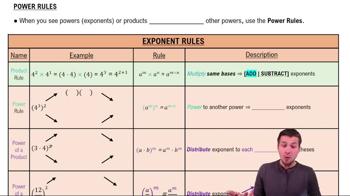
Power Rule for Derivatives

The Power Rule is a basic rule in calculus for finding the derivative of a function of the form f(x) = xⁿ, where n is any real number. The derivative is given by f'(x) = nxⁿ⁻¹. This rule simplifies the process of differentiation and is fundamental for understanding how to handle powers of x, including negative powers.
Video consigliato:
5:50
Power Rules

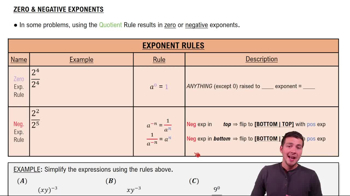
Negative Integer Exponents

Negative integer exponents indicate the reciprocal of the base raised to the corresponding positive exponent. For example, x⁻ᵐ is equivalent to 1/xᵐ. Understanding this concept is crucial when applying the Power Rule to negative exponents, as it involves rewriting the expression in a form suitable for differentiation using the Quotient Rule.
Video consigliato:
6:37
Zero and Negative Rules