Ch. 3 - Derivatives
Hass - Thomas' Calculus 15th Edition
Hass15th EditionThomas' CalculusISBN: 9780137616077Non è quello che usi tu?Cambia libro di testo
Capitolo 3, Problema 46

Quadratics having a common tangent line The curves y = x² + ax + b and y = cx − x² have a common tangent line at the point (1,0). Find a, b, and c.

Guida verificata passo dopo passo
1
First, find the derivative of each curve to determine the slope of the tangent line. For the curve y = x² + ax + b, the derivative is dy/dx = 2x + a. For the curve y = cx - x², the derivative is dy/dx = c - 2x.
Since the curves have a common tangent line at the point (1,0), the slopes of the tangent lines at x = 1 must be equal. Set the derivatives equal at x = 1: 2(1) + a = c - 2(1).
Solve the equation from the previous step to find a relationship between a and c: 2 + a = c - 2.
Next, ensure that the point (1,0) lies on both curves. Substitute x = 1 and y = 0 into each curve equation. For y = x² + ax + b, substitute to get 0 = 1² + a(1) + b. For y = cx - x², substitute to get 0 = c(1) - 1².
Solve the system of equations obtained from the previous steps to find the values of a, b, and c. Use the relationships: 0 = 1 + a + b and 0 = c - 1, along with the equation 2 + a = c - 2, to find the values of a, b, and c.

Risposta video verificata per un problema simile:

Questa soluzione video è stata consigliata dai nostri tutor come utile per risolvere questo problema.
Durata del video:
4m

Concetti chiave

Ecco i concetti essenziali che devi comprendere per rispondere correttamente alla domanda.

Tangent Line

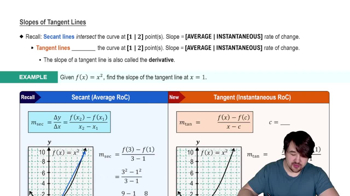
A tangent line to a curve at a given point is a straight line that touches the curve at that point and has the same slope as the curve at that point. To find the tangent line, we need to calculate the derivative of the function at the point of tangency, which gives us the slope, and then use the point-slope form of a line to express the tangent.
Video consigliato:
Percorso guidato
05:13
Slopes of Tangent Lines

Derivatives

Derivatives represent the rate of change of a function with respect to its variable. In this context, we will differentiate both quadratic functions to find their slopes at the point (1,0). Setting these derivatives equal at the point of tangency will help us establish a relationship between the coefficients a, b, and c.
Video consigliato:

Quadratic Functions

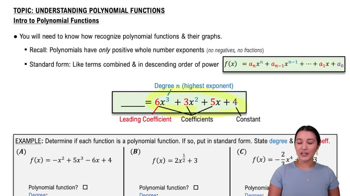
Quadratic functions are polynomial functions of degree two, typically expressed in the form y = ax² + bx + c. In this problem, we are dealing with two specific quadratic functions, and understanding their properties, such as vertex, axis of symmetry, and how they can intersect or share tangent lines, is crucial for solving for the unknown coefficients.
Video consigliato:
6:04
Introduction to Polynomial Functions