

Ch. 3 - Derivatives
Hass - Thomas' Calculus 15th Edition
Hass15th EditionThomas' CalculusISBN: 9780137616077Non è quello che usi tu?Cambia libro di testo
Capitolo 3, Problema 96c

Right circular cone The lateral surface area S of a right circular cone is related to the base radius r and height h by the equation
______
S = πr √ r² + h².


c. How is dS/dt related to dr/dt and dh/dt if neither r nor h is constant?

Guida verificata passo dopo passo
1
To find how dS/dt is related to dr/dt and dh/dt, we need to use implicit differentiation on the given formula for the lateral surface area of the cone: S = πr√(r² + h²).
First, identify the variables: S is the lateral surface area, r is the base radius, and h is the height. Both r and h are functions of time t, so we will differentiate with respect to t.
Apply the product rule to differentiate S = πr√(r² + h²) with respect to t. The product rule states that d(uv)/dt = u(dv/dt) + v(du/dt), where u = πr and v = √(r² + h²).
Differentiate u = πr with respect to t to get du/dt = π(dr/dt).
Differentiate v = √(r² + h²) with respect to t using the chain rule. The derivative of √(r² + h²) is (1/2)(r² + h²)^(-1/2) * (2r(dr/dt) + 2h(dh/dt)).

Risposta video verificata per un problema simile:

Questa soluzione video è stata consigliata dai nostri tutor come utile per risolvere questo problema.
Durata del video:
4m

Concetti chiave

Ecco i concetti essenziali che devi comprendere per rispondere correttamente alla domanda.

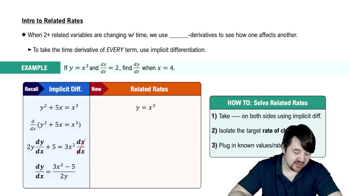
Related Rates

Related rates are a concept in calculus that deals with the relationship between different rates of change. When two or more variables are related by an equation, the rate of change of one variable can be expressed in terms of the rate of change of another. In this context, we are interested in how the lateral surface area of a cone changes with respect to time as both the radius and height change.
Video consigliato:
Percorso guidato
04:16
Intro To Related Rates

Differentiation

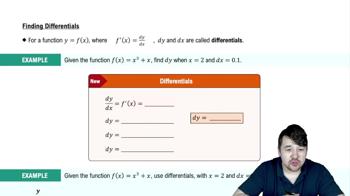
Differentiation is a fundamental concept in calculus that involves finding the derivative of a function. The derivative represents the rate of change of a function with respect to its variable. In the context of the given problem, we will differentiate the surface area equation with respect to time to find the relationship between the rates of change of the radius, height, and surface area.
Video consigliato:
Percorso guidato
05:53
Finding Differentials

Chain Rule

The chain rule is a formula used in calculus to compute the derivative of a composite function. It states that if a variable depends on another variable, which in turn depends on a third variable, the derivative of the outer function is multiplied by the derivative of the inner function. In this problem, we will apply the chain rule to relate the rates of change of the surface area, radius, and height of the cone.
Video consigliato:
05:02
Intro to the Chain Rule
Pratica correlata
Domanda del libro di testo

Resistors connected in parallel If two resistors of R₁ and R₂ ohms are connected in parallel in an electric circuit to make an R-ohm resistor, the value of R can be found from the equation


1/R = 1/R₁ + 1/R₂


<IMAGE>


If R₁ is decreasing at the rate of 1ohm/sec and R₂ is increasing at the rate of 0.5 ohm/sec, at what rate is R changing when R₁ = 75 ohms and R₂ = 50 ohms?

255
views
Domanda del libro di testo

The total surface area S of a right circular cylinder is related to the base radius r and height h by the equation S = 2πr² + 2πrh.


a. How is dS/dt related to dr/dt if h is constant?

238
views
Domanda del libro di testo

Temperature and the period of a pendulum For oscillations of small amplitude (short swings), we may safely model the relationship between the period T and the length L of a simple pendulum with the equation:


T = 2π√(L/g),


where g is the constant acceleration of gravity at the pendulum’s location. If we measure g in centimeters per second squared, we measure L in centimeters and T in seconds. If the pendulum is made of metal, its length will vary with temperature, either increasing or decreasing at a rate that is roughly proportional to L. In symbols, with u being temperature and k the proportionality constant,


dL/du = kL.


Assuming this to be the case, show that the rate at which the period changes with respect to temperature is kT/2.

268
views
Domanda del libro di testo

The lateral surface area S of a right circular cone is related to the base radius r and height h by the equation S = πr√(r² + h²). 

a. How is dS/dt related to dr/dt if h is constant?

227
views
Domanda del libro di testo

Moving searchlight beam The figure shows a boat 1 km offshore, sweeping the shore with a searchlight. The light turns at a constant rate, dθ/dt = -0.6 rad/sec.


b. How many revolutions per minute is 0.6 rad/sec?


<IMAGE>

181
views
Domanda del libro di testo

Draining a tank Water drains from the conical tank shown in the accompanying figure at the rate of 5 ft³/min.


a. What is the relation between the variables h and r in the figure?


<IMAGE>

333
views