

Ch. 3 - Derivatives
Hass - Thomas' Calculus 15th Edition
Hass15th EditionThomas' CalculusISBN: 9780137616077Non è quello che usi tu?Cambia libro di testo
Capitolo 3, Problema 3.6.76b

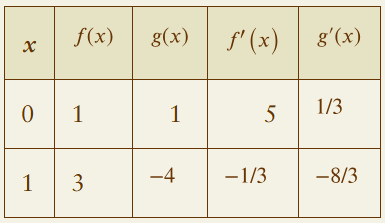
Suppose that the functions f and g and their derivatives with respect to x have the following values at x = 0 and x = 1.


<IMAGE>


Find the derivatives with respect to x of the following combinations at the given value of x.


b. f(x)g³(x), x = 0

Guida verificata passo dopo passo
1
Step 1: Recognize that the function to differentiate is f(x)g³(x). To find its derivative, use the product rule and the chain rule.
Step 2: Apply the product rule: If h(x) = f(x)g³(x), then h'(x) = f'(x)g³(x) + f(x) * d/dx[g³(x)].
Step 3: Use the chain rule to differentiate g³(x): d/dx[g³(x)] = 3g²(x)g'(x). Substitute this into the product rule.
Step 4: Substitute the values of f(x), g(x), f'(x), and g'(x) at x = 0 from the table into the derivative expression. Specifically, f(0) = 1, g(0) = 1, f'(0) = 5, and g'(0) = 1/3.
Step 5: Combine the terms from the product rule and chain rule to express the derivative at x = 0. Simplify the expression without calculating the final numerical value.

Risposta video verificata per un problema simile:

Questa soluzione video è stata consigliata dai nostri tutor come utile per risolvere questo problema.
Durata del video:
5m

Concetti chiave

Ecco i concetti essenziali che devi comprendere per rispondere correttamente alla domanda.

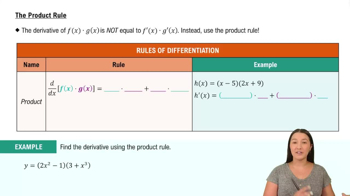
Product Rule

The product rule is a fundamental differentiation rule used when finding the derivative of the product of two functions. If u(x) and v(x) are differentiable functions, the derivative of their product is given by (uv)' = u'v + uv'. This rule is essential for solving problems involving the derivative of a product, such as f(x)g³(x).
Video consigliato:
05:18
The Product Rule

Chain Rule

The chain rule is used to differentiate composite functions. If a function y = g(u) and u = f(x), then the derivative dy/dx is found by multiplying the derivative of g with respect to u by the derivative of u with respect to x, or dy/dx = (dy/du) * (du/dx). This rule is crucial when dealing with functions raised to a power, like g³(x), where g(x) is a function of x.
Video consigliato:
05:02
Intro to the Chain Rule

Substitution of Values

Substitution involves replacing variables with specific values to evaluate expressions or derivatives at particular points. In this problem, after applying the product and chain rules, substitute x = 0 into the derived expression using the given values for f(x), g(x), f'(x), and g'(x) to find the derivative at x = 0. This step is necessary to obtain the numerical result.
Video consigliato:
04:27
Substitution With an Extra Variable
Pratica correlata