Ch. 3 - Derivatives
Hass - Thomas' Calculus 15th Edition
Hass15th EditionThomas' CalculusISBN: 9780137616077Non è quello che usi tu?Cambia libro di testo
Capitolo 3, Problema 26

The number of gallons of water in a tank t minutes after the tank has started to drain is Q(t) = 200(30 - t)². How fast is the water running out at the end of 10 min? What is the average rate at which the water flows out during the first 10 min?

Guida verificata passo dopo passo
1
To find how fast the water is running out at the end of 10 minutes, we need to calculate the derivative of Q(t) with respect to t, which gives us the rate of change of the water volume. This is represented as Q'(t).
First, apply the chain rule to differentiate Q(t) = 200(30 - t)². Let u = 30 - t, then Q(t) = 200u². The derivative of Q with respect to t is Q'(t) = 200 * 2u * (-1), because the derivative of u with respect to t is -1.
Substitute u back into the expression: Q'(t) = 200 * 2(30 - t) * (-1) = -400(30 - t).
Evaluate Q'(t) at t = 10 to find the instantaneous rate of change at that moment: Q'(10) = -400(30 - 10).
To find the average rate at which the water flows out during the first 10 minutes, use the formula for the average rate of change: (Q(10) - Q(0)) / (10 - 0). Calculate Q(10) and Q(0) using the original function Q(t) = 200(30 - t)², then compute the average rate.

Risposta video verificata per un problema simile:

Questa soluzione video è stata consigliata dai nostri tutor come utile per risolvere questo problema.
Durata del video:
6m

Concetti chiave

Ecco i concetti essenziali che devi comprendere per rispondere correttamente alla domanda.

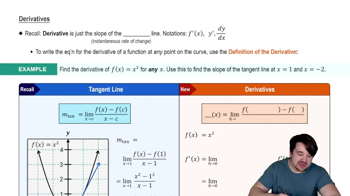
Derivative

The derivative of a function measures how the function's output changes as its input changes. In this context, the derivative of Q(t) with respect to t gives the rate at which water is draining from the tank at any given time. Calculating the derivative at t = 10 will provide the instantaneous rate of water flow at that moment.
Video consigliato:

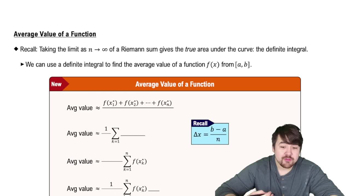
Average Rate of Change

The average rate of change of a function over an interval is calculated by taking the difference in the function's values at the endpoints of the interval and dividing by the length of the interval. For the first 10 minutes, this concept helps determine the average rate at which water flows out by evaluating Q(t) at t = 0 and t = 10 and dividing the difference by 10.
Video consigliato:
Percorso guidato
06:37
Average Value of a Function

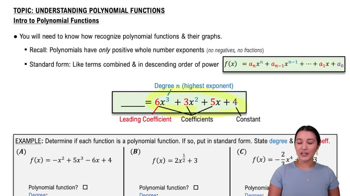
Quadratic Function

A quadratic function is a polynomial function of degree two, typically in the form ax² + bx + c. The function Q(t) = 200(30 - t)² is quadratic, and understanding its properties, such as its vertex and symmetry, can help in analyzing how the quantity of water changes over time. This understanding is crucial for calculating derivatives and average rates.
Video consigliato:
6:04
Introduction to Polynomial Functions
Pratica correlata
Domanda del libro di testo

[Technology Exercise]


Draining a tank It takes 12 hours to drain a storage tank by opening the valve at the bottom. The depth y of fluid in the tank t hours after the valve is opened is given by the formula


y = 6(1 - t/12)² m.


a. Find the rate dy/dt (m/h) at which the tank is draining at time t.

244
views
Domanda del libro di testo

[Technology Exercise]


Draining a tank It takes 12 hours to drain a storage tank by opening the valve at the bottom. The depth y of fluid in the tank t hours after the valve is opened is given by the formula


y = 6(1 - t/12)² m.


b. When is the fluid level in the tank falling fastest? Slowest? What are the values of dy/dt at these times?

235
views
Domanda del libro di testo

Vehicular stopping distance Based on data from the U.S. Bureau of Public Roads, a model for the total stopping distance of a moving car in terms of its speed is s = 1.1v + 0.054v², where s is measured in ft and v in mph. The linear term 1.1v models the distance the car travels during the time the driver perceives a need to stop until the brakes are applied, and the quadratic term 0.054v² models the additional braking distance once they are applied. Find ds/dv at v = 35 and v = 70 mph, and interpret the meaning of the derivative.

208
views
Domanda del libro di testo

Using the Alternative Formula for Derivatives


Use the formula

f'(x) = lim (z → x) (f(z) − f(x)) / (z − x)

to find the derivative of the functions in Exercises 23–26.


f(x) = x² − 3x + 4

272
views
Domanda del libro di testo

Slopes and Tangent Lines


b. Smallest slope What is the smallest slope on the curve? At what point on the curve does the curve have this slope?

298
views
Domanda del libro di testo

Airplane takeoff Suppose that the distance an aircraft travels along a runway before takeoff is given by D = (10/9)t², where D is measured in meters from the starting point and t is measured in seconds from the time the brakes are released. The aircraft will become airborne when its speed reaches 200 km/h. How long will it take to become airborne, and what distance will it travel in that time?

220
views