
Ch. 3 - Derivatives
Hass - Thomas' Calculus 15th Edition
Hass15th EditionThomas' CalculusISBN: 9780137616077Non è quello che usi tu?Cambia libro di testo
Capitolo 3, Problema 3.9.48a

Tolerance


a. About how accurately must the interior diameter of a 10-m-high cylindrical storage tank be measured to calculate the tank’s volume to within 1% of its true value?

Guida verificata passo dopo passo
1
First, recall the formula for the volume of a cylinder: \( V = \pi r^2 h \), where \( r \) is the radius and \( h \) is the height of the cylinder.
Since the problem involves the interior diameter, note that the diameter \( d = 2r \). Therefore, the radius \( r = \frac{d}{2} \).
To find the tolerance in the diameter, we need to consider the derivative of the volume with respect to the diameter. Start by expressing the volume in terms of the diameter: \( V = \pi \left(\frac{d}{2}\right)^2 h = \frac{\pi d^2 h}{4} \).
Differentiate the volume with respect to the diameter \( d \) to find \( \frac{dV}{dd} = \frac{\pi dh}{2} \). This represents the rate of change of volume with respect to changes in diameter.
Set up the equation for the tolerance: \( \frac{dV}{V} = \frac{1}{100} \). Substitute \( \frac{dV}{dd} \) and solve for the change in diameter \( dd \) that corresponds to a 1% change in volume. This will give you the required accuracy for measuring the diameter.

Risposta video verificata per un problema simile:

Questa soluzione video è stata consigliata dai nostri tutor come utile per risolvere questo problema.
Durata del video:
4m

Concetti chiave

Ecco i concetti essenziali che devi comprendere per rispondere correttamente alla domanda.

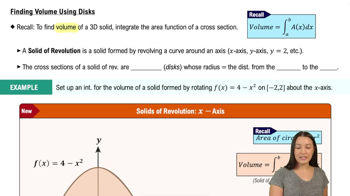
Volume of a Cylinder

The volume of a cylinder is calculated using the formula V = πr²h, where r is the radius and h is the height. Understanding this formula is crucial because the problem involves calculating the volume of a cylindrical tank. The accuracy of the diameter measurement directly affects the radius, which in turn impacts the volume calculation.
Video consigliato:
04:48
Finding Volume Using Disks

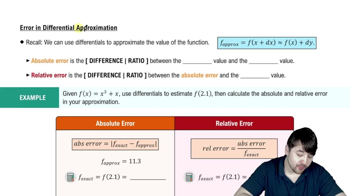
Percentage Error

Percentage error is a measure of how inaccurate a measurement is, compared to the true value, expressed as a percentage. In this problem, the goal is to ensure the calculated volume is within 1% of the true volume. This concept helps in determining the acceptable range of error in the diameter measurement to achieve the desired accuracy in volume calculation.
Video consigliato:
Percorso guidato
04:57
Determining Error and Relative Error

Differential Calculus

Differential calculus involves the study of how functions change when their inputs change. It is used here to determine how small changes in the diameter affect the volume of the cylinder. By using derivatives, one can estimate the change in volume with respect to a change in diameter, which is essential for calculating the required measurement accuracy.
Video consigliato:
Percorso guidato
06:11
Fundamental Theorem of Calculus Part 1