
Ch. 3 - Derivatives
Hass - Thomas' Calculus 15th Edition
Hass15th EditionThomas' CalculusISBN: 9780137616077Non è quello che usi tu?Cambia libro di testo
Capitolo 3, Problema 17b

Understanding Motion from Graphs


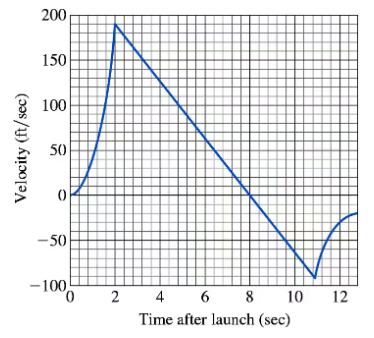
Launching a Rocket When a model rocket is launched, the propellant burns for a few seconds, accelerating the rocket upward. After burnout, the rocket coasts upward for a while and then begins to fall. A small explosive charge pops out a parachute shortly after the rocket starts down. The parachute slows the rocket to keep it from breaking when it lands.


The figure here shows velocity data from the flight of the model rocket. Use the data to answer the following.


b. For how many seconds did the engine burn?


rock2

Guida verificata passo dopo passo
1
Examine the graph to identify the period during which the rocket is accelerating upwards. This is indicated by a positive slope in the velocity-time graph.
Notice that the velocity increases from 0 ft/sec to a peak value, indicating the engine is burning and accelerating the rocket.
Determine the time interval from the start (0 seconds) to the point where the velocity reaches its maximum value. This is the duration of the engine burn.
On the graph, locate the time at which the velocity reaches its maximum value. This is where the slope changes from positive to negative, indicating the end of the engine burn.
Read the time value at this point from the x-axis. This time value represents the number of seconds the engine burned.

Risposta video verificata per un problema simile:

Questa soluzione video è stata consigliata dai nostri tutor come utile per risolvere questo problema.
Durata del video:
3m

Concetti chiave

Ecco i concetti essenziali che devi comprendere per rispondere correttamente alla domanda.

Velocity-Time Graphs

A velocity-time graph illustrates how an object's velocity changes over time. The vertical axis represents velocity, while the horizontal axis represents time. The slope of the graph indicates acceleration, and the area under the curve represents displacement. Understanding this graph is crucial for analyzing the motion of the rocket during its flight.
Video consigliato:
Percorso guidato
06:29
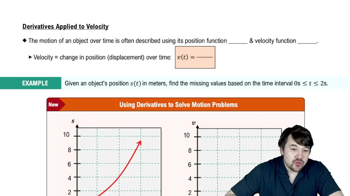
Derivatives Applied To Velocity

Acceleration

Acceleration is the rate of change of velocity with respect to time. It can be positive (speeding up) or negative (slowing down). In the context of the rocket, acceleration occurs during the engine burn phase, where the rocket's velocity increases. Identifying the duration of the engine burn involves determining the time interval during which the velocity is increasing.
Video consigliato:
Percorso guidato
06:15
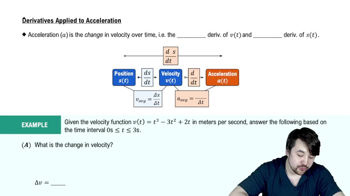
Derivatives Applied To Acceleration

Area Under the Curve

The area under a velocity-time graph represents the displacement of the object over a given time interval. In this scenario, calculating the area under the curve can help determine how far the rocket traveled during its ascent and descent. This concept is essential for understanding the overall motion of the rocket and answering questions related to its flight.
Video consigliato:
Percorso guidato
05:59
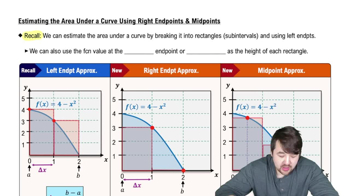
Estimating the Area Under a Curve with Right Endpoints & Midpoint
Pratica correlata
Domanda del libro di testo

Understanding Motion from Graphs


Launching a Rocket When a model rocket is launched, the propellant burns for a few seconds, accelerating the rocket upward. After burnout, the rocket coasts upward for a while and then begins to fall. A small explosive charge pops out a parachute shortly after the rocket starts down. The parachute slows the rocket to keep it from breaking when it lands.


The figure here shows velocity data from the flight of the model rocket. Use the data to answer the following.


d. When did the parachute pop out? How fast was the rocket falling then?


213
views
Domanda del libro di testo

Understanding Motion from Graphs


Launching a Rocket When a model rocket is launched, the propellant burns for a few seconds, accelerating the rocket upward. After burnout, the rocket coasts upward for a while and then begins to fall. A small explosive charge pops out a parachute shortly after the rocket starts down. The parachute slows the rocket to keep it from breaking when it lands.


The figure here shows velocity data from the flight of the model rocket. Use the data to answer the following.


c. When did the rocket reach its highest point? What was its velocity then?


225
views
Domanda del libro di testo

Understanding Motion from Graphs


Launching a Rocket When a model rocket is launched, the propellant burns for a few seconds, accelerating the rocket upward. After burnout, the rocket coasts upward for a while and then begins to fall. A small explosive charge pops out a parachute shortly after the rocket starts down. The parachute slows the rocket to keep it from breaking when it lands.


The figure here shows velocity data from the flight of the model rocket. Use the data to answer the following.


f. When was the rocket’s acceleration greatest?


224
views
Domanda del libro di testo

Understanding Motion from Graphs


Launching a Rocket When a model rocket is launched, the propellant burns for a few seconds, accelerating the rocket upward. After burnout, the rocket coasts upward for a while and then begins to fall. A small explosive charge pops out a parachute shortly after the rocket starts down. The parachute slows the rocket to keep it from breaking when it lands.


The figure here shows velocity data from the flight of the model rocket. Use the data to answer the following.


a. How fast was the rocket climbing when the engine stopped?


349
views
Domanda del libro di testo

Slopes and Tangent Lines


In Exercises 13–16, differentiate the functions and find the slope of the tangent line at the given value of the independent variable.


y = (x + 3)/(1 – x), x = −2

183
views
Domanda del libro di testo

Slopes and Tangent Lines


In Exercises 13–16, differentiate the functions and find the slope of the tangent line at the given value of the independent variable.


f(x) = x + 9/x, x = −3

160
views