


Ch. 4 - Applications of Derivatives
Hass - Thomas' Calculus 15th Edition
Hass15th EditionThomas' CalculusISBN: 9780137616077Non è quello che usi tu?Cambia libro di testo
Capitolo 4, Problema 4.4.107

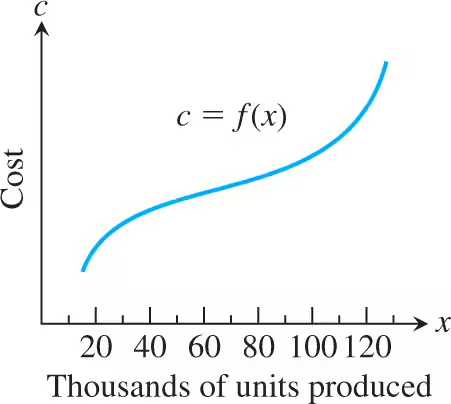
107. Marginal cost The accompanying graph shows the hypothetical cost c=f(x) of manufacturing x items. At approximately what production level does the marginal cost change from decreasing to increasing?
Graph showing cost versus production level, illustrating the marginal cost's transition from decreasing to increasing.

Guida verificata passo dopo passo
1
Step 1: Understand the concept of marginal cost. Marginal cost is the derivative of the cost function c=f(x) with respect to the number of items produced, x. It represents the rate of change of cost as production increases.
Step 2: Analyze the graph provided. The graph shows the cost function c=f(x) as a curve. To determine where the marginal cost changes from decreasing to increasing, we need to identify the point where the slope of the tangent to the curve transitions from decreasing to increasing.
Step 3: Look for the inflection point on the graph. An inflection point is where the curvature of the graph changes, which corresponds to the second derivative of the cost function changing sign. This is the point where the marginal cost transitions from decreasing to increasing.
Step 4: Estimate the production level at the inflection point. From the graph, observe the curve's behavior and approximate the x-value (production level) where the slope of the tangent stops decreasing and starts increasing. This appears to be around x=60 thousand units.
Step 5: Conclude that the marginal cost changes from decreasing to increasing at approximately x=60 thousand units. This is based on the visual analysis of the graph and the concept of inflection points.

Risposta video verificata per un problema simile:

Questa soluzione video è stata consigliata dai nostri tutor come utile per risolvere questo problema.
Durata del video:
2m

Concetti chiave

Ecco i concetti essenziali che devi comprendere per rispondere correttamente alla domanda.

Marginal Cost

Marginal cost refers to the additional cost incurred when producing one more unit of a good or service. It is derived from the cost function, c = f(x), by calculating the derivative, f'(x). Understanding where marginal cost increases or decreases helps businesses make informed production decisions.
Video consigliato:
07:32
Example 3: Maximizing Profit

Cost Function

The cost function, represented as c = f(x), describes the total cost of producing x units of a product. It typically reflects fixed and variable costs and can be analyzed to determine how costs change with varying production levels. The shape of this function is crucial for identifying points of marginal cost change.
Video consigliato:
Percorso guidato
06:21
Properties of Functions

Inflection Point

An inflection point on a graph is where the curvature changes, indicating a transition in the behavior of the function. In the context of marginal cost, it marks the production level where the marginal cost shifts from decreasing to increasing, which is essential for optimizing production efficiency and cost management.
Video consigliato:
04:50
Critical Points
Pratica correlata
Domanda del libro di testo

Identifying Extrema


In Exercises 19–40:


a. Find the open intervals on which the function is increasing and those on which it is decreasing.


b. Identify the function’s local extreme values, if any, saying where they occur.


f(x) = x − 6√(x − 1)

152
views
Domanda del libro di testo

Identifying Extrema


In Exercises 15–18:


a. Find the open intervals on which the function is increasing and those on which it is decreasing.


b. Identify the function’s local and absolute extreme values, if any, saying where they occur.


206
views
Domanda del libro di testo

26. Constructing cylinders Compare the answers to the following two construction problems.

a. A rectangular sheet of perimeter 36 cm and dimensions x cm by y cm is to be rolled into a cylinder as shown in part (a) of the figure. What values of x and y give the largest volume?

b. The same sheet is to be revolved about one of the sides of length y to sweep out the cylinder as shown in part (b) of the figure. What values of x and y give the largest volume?

" style="" width="350">

189
views
Domanda del libro di testo

Theory and Examples


In Exercises 53 and 54, show that the function has neither an absolute minimum nor an absolute maximum on its natural domain.


y = x¹¹ + x³ + x − 5

206
views
Domanda del libro di testo

Checking the Mean Value Theorem


Find the value or values of c that satisfy the equation (f(b) − f(a)) / (b − a) = f′(c) in the conclusion of the Mean Value Theorem for the functions and intervals in Exercises 1–6.


f(x) =√(x − 1), [1, 3]

259
views
Domanda del libro di testo

Applications


A marathoner ran the 26.2-mi New York City Marathon in 2.2 hours. Show that at least twice the marathoner was running at exactly 11 mph, assuming the initial and final speeds are zero.

213
views