
Finding Indefinite Integrals
Find the indefinite integrals (most general antiderivatives) in Exercises 73–88. You may need to try a solution and then adjust your guess. Check your answers by differentiation.
∫ sec² s/10 ds

 Guida verificata passo dopo passo
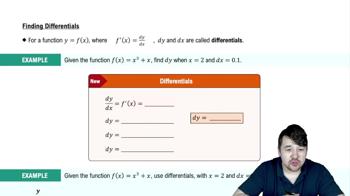
 05:53
05:53
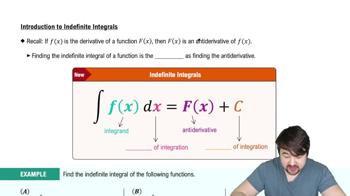 05:04
05:04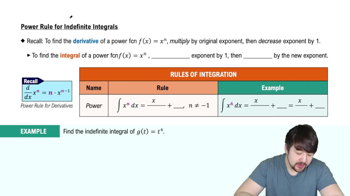 04:04
04:04Finding Indefinite Integrals
Find the indefinite integrals (most general antiderivatives) in Exercises 73–88. You may need to try a solution and then adjust your guess. Check your answers by differentiation.
∫ sec² s/10 ds
Checking Antiderivative Formulas
Right, or wrong? Say which for each formula and give a brief reason for each answer.
∫√(2x + 1) dx = √(x² + x +C)
Finding Indefinite Integrals
Find the indefinite integrals (most general antiderivatives) in Exercises 73–88. You may need to try a solution and then adjust your guess. Check your answers by differentiation.
∫ 1/( r + 5)²dr
Identifying Extrema
In Exercises 41–52:
a. Identify the function’s local extreme values in the given domain, and say where they occur.
f(t) = 12t − t³, −3 ≤ t < ∞
Finding Antiderivatives
In Exercises 1–16, find an antiderivative for each function. Do as many as you can mentally. Check your answers by differentiation.
2x
Identifying Extrema
In Exercises 63 and 64, the graph of f' is given. Assume that f has domain (-2, 2).
" style="" width="190">
a. Either use the graph to determine which intervals f is increasing on and which intervals f is decreasing on, or explain why this information cannot be determined from the graph.