

As a result of a heavy rain, the volume of water in a reservoir increased by 1400 acre-ft in 24 hours. Show that at some instant during that period the reservoir’s volume was increasing at a rate in excess of 225,000 gal/min. (An acre-foot is 43,560 ft³, the volume that would cover 1 acre to the depth of 1 ft. A cubic foot holds 7.48 gal.)
Calculate the first derivatives of ƒ(𝓍) = 𝓍²/ (𝓍² + 1) and g(𝓍) = ―1/ (𝓍² + 1) . What can you conclude about the graphs of these functions?
Guida verificata passo dopo passo
Risposta video verificata per un problema simile:
Concetti chiave
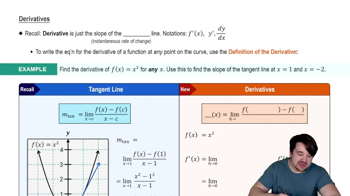
Derivative
Quotient Rule
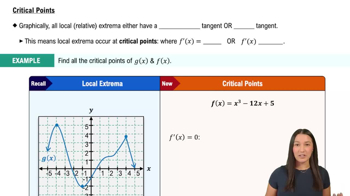
Graph Behavior and Critical Points
Finding Functions from Derivatives
Suppose that f'(x) = 2x for all x. Find f(2) if
a. f(0) = 0
In Exercises 9–66, graph the function using appropriate methods from the graphing procedures presented just before Example 9, identifying the coordinates of any local extreme points and inflection points. Then find coordinates of absolute extreme points, if any.
y = (x² - 49) / (x² + 5x - 14)
In Exercises 9–66, graph the function using appropriate methods from the graphing procedures presented just before Example 9, identifying the coordinates of any local extreme points and inflection points. Then find coordinates of absolute extreme points, if any.
30. y = (x² - 4) / (x² - 2)
Finding Functions from Derivatives
Suppose that f(−1) = 3 and that f'(x) = 0 for all x. Must f(x) = 3 for all x? Give reasons for your answer.
Finding Functions from Derivatives
Suppose that f'(x) = 2x for all x. Find f(2) if
b. f(1) = 0
