
Domanda del libro di testo
Checking Antiderivative Formulas
Right, or wrong? Say which for each formula and give a brief reason for each answer.
∫tanθ sec²θ dθ = (1/2) sec²θ + C
26
views

 Guida verificata passo dopo passo
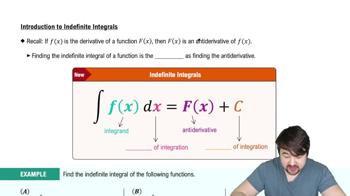
 05:04
05:04
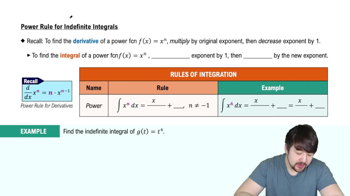 04:04
04:04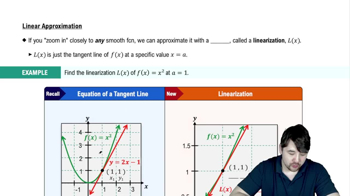 07:17
07:17Checking Antiderivative Formulas
Right, or wrong? Say which for each formula and give a brief reason for each answer.
∫tanθ sec²θ dθ = (1/2) sec²θ + C
Theory and Examples
In Exercises 51 and 52, give reasons for your answers.
Let f(x) = |x³ − 9x|.
b. Does f'(-3) exist?
Analyzing Functions from Derivatives
Answer the following questions about the functions whose derivatives are given in Exercises 1–14:
c. At what points, if any, does f assume local maximum or minimum values?
f′(x) = (x − 1)²(x + 2)
Finding Antiderivatives
In Exercises 1–16, find an antiderivative for each function. Do as many as you can mentally. Check your answers by differentiation.
−π csc (πx/2) cot (πx/2)
105. Motion Along a Line The graphs in Exercises 105 and 106 show the position s=f(t) of an object moving up and down on a coordinate line. At approximately what times is the (c) Acceleration equal to zero?
Analyzing Functions from Derivatives
Answer the following questions about the functions whose derivatives are given in Exercises 1–14:
c. At what points, if any, does f assume local maximum or minimum values?
f′(x) = 1− 4/x², x ≠ 0