Ch. 4 - Applications of Derivatives
Hass - Thomas' Calculus 15th Edition
Hass15th EditionThomas' CalculusISBN: 9780137616077Non è quello che usi tu?Cambia libro di testo
Capitolo 4, Problema 4.7.12a

Finding Antiderivatives
In Exercises 1–16, find an antiderivative for each function. Do as many as you can mentally. Check your answers by differentiation.
πcos πx

Guida verificata passo dopo passo
1
Identify the function you need to find the antiderivative of, which is \(\pi \cos \pi x\).
Recall that the antiderivative (indefinite integral) of \(\cos(ax)\) with respect to \(x\) is \(\frac{1}{a} \sin(ax) + C\), where \(a\) is a constant and \(C\) is the constant of integration.
Apply this rule to the function \(\pi \cos \pi x\). Since the function has a constant multiplier \(\pi\), factor it out and integrate \(\cos \pi x\).
Integrate \(\cos \pi x\) to get \(\frac{1}{\pi} \sin \pi x + C\). Then multiply by the constant \(\pi\) outside the integral.
Combine the results to write the antiderivative as \(\pi \times \frac{1}{\pi} \sin \pi x + C\), which simplifies to \(\sin \pi x + C\). Remember to verify your answer by differentiating it to check if you get back the original function.

Risposta video verificata per un problema simile:

Questa soluzione video è stata consigliata dai nostri tutor come utile per risolvere questo problema.
Durata del video:
3m

Concetti chiave

Ecco i concetti essenziali che devi comprendere per rispondere correttamente alla domanda.

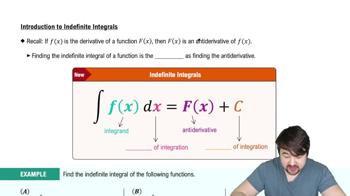
Antiderivative (Indefinite Integral)

An antiderivative of a function is another function whose derivative equals the original function. It represents the reverse process of differentiation and is expressed with an arbitrary constant since differentiation of a constant is zero.
Video consigliato:
Percorso guidato
05:04
Introduction to Indefinite Integrals

Integration of Trigonometric Functions

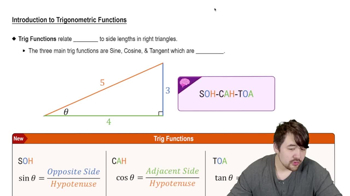
Integrating trigonometric functions like cosine involves recognizing standard integral forms. For example, the integral of cos(kx) dx is (1/k) sin(kx) + C, where k is a constant multiplier inside the function's argument.
Video consigliato:
Percorso guidato
6:04
Introduction to Trigonometric Functions

Verification by Differentiation

After finding an antiderivative, differentiating it should return the original function. This step confirms the correctness of the antiderivative and helps identify any missing constants or errors in integration.
Video consigliato:
Percorso guidato
05:53
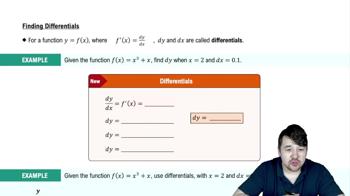
Finding Differentials
Pratica correlata
Domanda del libro di testo

Identifying Extrema


In Exercises 41–52:


a. Identify the function’s local extreme values in the given domain, and say where they occur.


g(x) = −x² − 6x − 9,−4 ≤ x < ∞

160
views

Domanda del libro di testo

53. Distance between two ships At noon, ship A was 12 nautical miles due north of ship B. Ship A was sailing south at 12 knots (nautical miles per hour; a nautical mile is 2000 yd) and continued to do so all day. Ship B was sailing east at 8 knots and continued to do so all day.

a. Start counting time with t=0 at noon and express the distance s between the ships as a function of t.

232
views
Domanda del libro di testo

Theory and Examples


Sketch the graph of a differentiable function y = f(x) that has a local minimum at (1, 1) and a local maximum at (3, 3).

218
views
Domanda del libro di testo

Finding displacement from an antiderivative of velocity


a. Suppose that the velocity of a body moving along the s-axis is


ds/dt = v = 9.8t − 3.


i. Find the body’s displacement over the time interval from t = 1 to t = 3 given that s = 5 when t = 0.

36
views
Domanda del libro di testo

Checking Antiderivative Formulas


Right, or wrong? Say which for each formula and give a brief reason for each answer.


∫tanθ sec²θ dθ = sec³θ / 3 + C

36
views
Domanda del libro di testo

Analyzing Functions from Derivatives


Answer the following questions about the functions whose derivatives are given in Exercises 1–14:


a. What are the critical points of f?


f′(x) = (x − 1)(x + 2)(x − 3)

231
views