Ch. 4 - Applications of Derivatives
Hass - Thomas' Calculus 15th Edition
Hass15th EditionThomas' CalculusISBN: 9780137616077Non è quello che usi tu?Cambia libro di testo
Capitolo 4, Problema 4.2.37

Finding Functions from Derivatives


In Exercises 37–40, find the function with the given derivative whose graph passes through the point P.


f'(x) = 2x − 1, P(0,0)

Guida verificata passo dopo passo
1
To find the original function f(x) from its derivative f'(x) = 2x - 1, we need to perform integration. The process of finding a function from its derivative is called antidifferentiation or integration.
Integrate the derivative f'(x) = 2x - 1 with respect to x. This means we need to find the indefinite integral of 2x - 1. The integral of 2x is x^2, and the integral of -1 is -x. Therefore, the integral of f'(x) is: ∫(2x - 1) dx = x^2 - x + C, where C is the constant of integration.
The constant C represents an unknown value that can be determined using the given point P(0,0). Substitute x = 0 and f(x) = 0 into the equation f(x) = x^2 - x + C to find C.
Substituting the point P(0,0) into the equation gives: 0 = 0^2 - 0 + C, which simplifies to C = 0.
Now that we have determined C, the function f(x) is x^2 - x. Therefore, the function whose derivative is 2x - 1 and passes through the point P(0,0) is f(x) = x^2 - x.

Risposta video verificata per un problema simile:

Questa soluzione video è stata consigliata dai nostri tutor come utile per risolvere questo problema.
Durata del video:
4m

Concetti chiave

Ecco i concetti essenziali che devi comprendere per rispondere correttamente alla domanda.

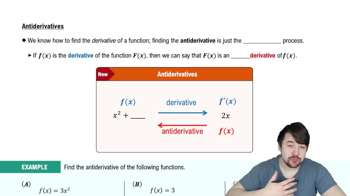
Antiderivatives

An antiderivative of a function is another function whose derivative is the original function. To find a function from its derivative, we perform integration, which is the reverse process of differentiation. In this context, finding the antiderivative of f'(x) = 2x - 1 will yield the original function f(x).
Video consigliato:
Percorso guidato
05:50
Antiderivatives

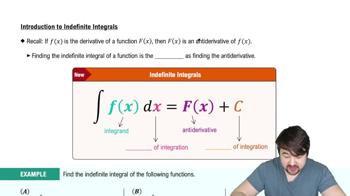
Integration

Integration is the process of finding the antiderivative of a function. It involves determining a function whose derivative is the given function. For f'(x) = 2x - 1, integrating with respect to x will provide the general form of f(x), which includes an arbitrary constant C.
Video consigliato:
Percorso guidato
05:04
Introduction to Indefinite Integrals

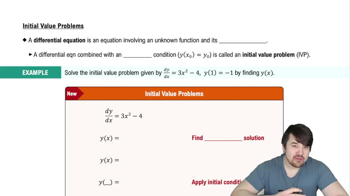
Initial Conditions

Initial conditions are used to find the specific solution to a differential equation by determining the constant of integration. Given the point P(0,0), we substitute x = 0 and f(x) = 0 into the integrated function to solve for C, ensuring the function passes through the specified point.
Video consigliato:
Percorso guidato
05:03
Initial Value Problems
Pratica correlata
Domanda del libro di testo

Finding Critical Points


In Exercises 41–50, determine all critical points and all domain endpoints for each function.


f(x) = x(4 − x)³

188
views

Domanda del libro di testo

110. Suppose the derivative of the function y = f(x) is

y'=(x-1)^22(x-2)(x-4).

At what points, if any, does the graph of f have a local minimum, local maximum, or

point of inflection?

166
views
Domanda del libro di testo

In Exercises 9–66, graph the function using appropriate methods from the graphing procedures presented just before Example 9, identifying the coordinates of any local extreme points and inflection points. Then find coordinates of absolute extreme points, if any.

y = 1 / (x² - 1)

101
views
Domanda del libro di testo

Identifying Extrema


In Exercises 19–40:


a. Find the open intervals on which the function is increasing and those on which it is decreasing.


b. Identify the function’s local extreme values, if any, saying where they occur.


f(x) = x − 6√(x − 1)

152
views
Domanda del libro di testo

Identify the inflection points and local maxima and minima of the functions graphed in Exercises 1–8. Identify the open intervals on which the functions are differentiable and the graphs are concave up and concave down.

7. y=sin|x|, -2π≤x≤2π

182
views
Domanda del libro di testo

22. A window is in the form of a rectangle surmounted by a semicircle. The rectangle is of clear glass, whereas the semicircle is of tinted glass that transmits only half as much light per unit area as clear glass does. The total perimeter is fixed. Find the proportions of the window that will admit the most light. Neglect the thickness of the frame.

" style="" width="180">

175
views