
Ch. 4 - Applications of Derivatives
Hass - Thomas' Calculus 15th Edition
Hass15th EditionThomas' CalculusISBN: 9780137616077Non è quello che usi tu?Cambia libro di testo
Capitolo 4, Problema 4.7.33

Finding Indefinite Integrals


In Exercises 17–56, find the most general antiderivative or indefinite integral. You may need to try a solution and then adjust your guess. Check your answers by differentiation.


∫(t√t + √t) / t² dt

Guida verificata passo dopo passo
1
First, simplify the integrand by expressing all terms with exponents. Recall that \( \sqrt{t} = t^{1/2} \) and rewrite the expression inside the integral accordingly.
Rewrite the integrand \( \frac{t\sqrt{t} + \sqrt{t}}{t^2} \) as \( \frac{t \cdot t^{1/2} + t^{1/2}}{t^2} = \frac{t^{3/2} + t^{1/2}}{t^2} \).
Split the fraction into two separate terms: \( \frac{t^{3/2}}{t^2} + \frac{t^{1/2}}{t^2} \). Then simplify each term by subtracting exponents in the denominator from those in the numerator.
After simplification, express the integrand as a sum of powers of \( t \): \( t^{3/2 - 2} + t^{1/2 - 2} = t^{-1/2} + t^{-3/2} \).
Now, integrate each term separately using the power rule for integration: \( \int t^n dt = \frac{t^{n+1}}{n+1} + C \), making sure to add the constant of integration at the end.

Risposta video verificata per un problema simile:

Questa soluzione video è stata consigliata dai nostri tutor come utile per risolvere questo problema.
Durata del video:
5m

Concetti chiave

Ecco i concetti essenziali che devi comprendere per rispondere correttamente alla domanda.

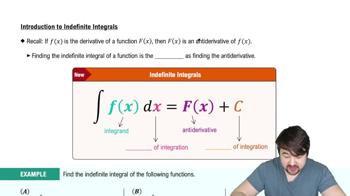
Indefinite Integral and Antiderivative

An indefinite integral represents the most general antiderivative of a function, including a constant of integration. It reverses differentiation, finding a function whose derivative matches the integrand. Understanding this helps in solving integrals without specified limits.
Video consigliato:
Percorso guidato
05:04
Introduction to Indefinite Integrals

Algebraic Simplification of the Integrand

Before integrating, simplify the integrand by combining like terms and rewriting expressions using exponent rules. For example, rewrite roots as fractional exponents and simplify fractions to make integration straightforward and reduce errors.
Video consigliato:
05:22
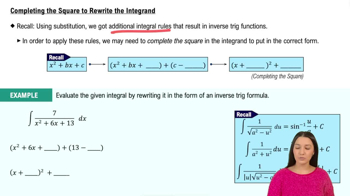
Completing the Square to Rewrite the Integrand

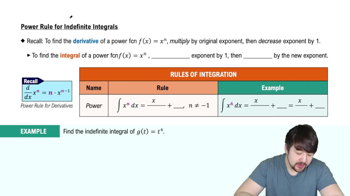
Power Rule for Integration

The power rule states that ∫x^n dx = (x^(n+1))/(n+1) + C for any real number n ≠ -1. This rule is fundamental for integrating polynomial and power functions, allowing direct computation once the integrand is expressed in terms of powers.
Video consigliato:
Percorso guidato
04:04
Power Rule for Indefinite Integrals
Pratica correlata
Domanda del libro di testo

In Exercises 9–66, graph the function using appropriate methods from the graphing procedures presented just before Example 9, identifying the coordinates of any local extreme points and inflection points. Then find coordinates of absolute extreme points, if any.

39. y = 8 / (x² + 4) (Witch of Agnesi)

102
views
Domanda del libro di testo

Finding Indefinite Integrals


In Exercises 17–56, find the most general antiderivative or indefinite integral. You may need to try a solution and then adjust your guess. Check your answers by differentiation.


∫(1 − cot²x) dx

35
views
Domanda del libro di testo

Finding Indefinite Integrals


In Exercises 17–56, find the most general antiderivative or indefinite integral. You may need to try a solution and then adjust your guess. Check your answers by differentiation.


∫x⁻¹ᐟ³ dx

23
views
Domanda del libro di testo

Finding Indefinite Integrals


In Exercises 17–56, find the most general antiderivative or indefinite integral. You may need to try a solution and then adjust your guess. Check your answers by differentiation.


∫(8y − 2 / y¹ᐟ⁴) dy

19
views
Domanda del libro di testo

Each of Exercises 67–88 gives the first derivative of a continuous function y=f(x). Find y'' and then use Steps 2–4 of the graphing procedure described in this section to sketch the general shape of the graph of f.

77. y' = cot(θ/2), for 0 < θ < 2π

112
views
Domanda del libro di testo

Initial Value Problems


Solve the initial value problems in Exercises 71–90.


dy/dx = 1/x² + x, x > 0; y(2) = 1

14
views