Ch. 4 - Applications of Derivatives
Hass - Thomas' Calculus 15th Edition
Hass15th EditionThomas' CalculusISBN: 9780137616077Non è quello che usi tu?Cambia libro di testo
Capitolo 4, Problema 4.3.23b

Identifying Extrema


In Exercises 19–40:


b. Identify the function’s local extreme values, if any, saying where they occur.


f(θ) = 3θ² − 4θ³

Guida verificata passo dopo passo
1
To identify the local extrema of the function \( f(\theta) = 3\theta^2 - 4\theta^3 \), first find the derivative \( f'(\theta) \). This will help us locate critical points where extrema might occur.
Calculate the derivative: \( f'(\theta) = \frac{d}{d\theta}(3\theta^2 - 4\theta^3) = 6\theta - 12\theta^2 \).
Set the derivative equal to zero to find critical points: \( 6\theta - 12\theta^2 = 0 \). Factor the equation: \( 6\theta(1 - 2\theta) = 0 \). This gives us \( \theta = 0 \) and \( \theta = \frac{1}{2} \) as critical points.
Determine the nature of these critical points by using the second derivative test. Find the second derivative: \( f''(\theta) = \frac{d}{d\theta}(6\theta - 12\theta^2) = 6 - 24\theta \).
Evaluate \( f''(\theta) \) at the critical points: For \( \theta = 0 \), \( f''(0) = 6 \) (positive, indicating a local minimum). For \( \theta = \frac{1}{2} \), \( f''\left(\frac{1}{2}\right) = 6 - 24\left(\frac{1}{2}\right) = -6 \) (negative, indicating a local maximum). Thus, the function has a local minimum at \( \theta = 0 \) and a local maximum at \( \theta = \frac{1}{2} \).

Risposta video verificata per un problema simile:

Questa soluzione video è stata consigliata dai nostri tutor come utile per risolvere questo problema.
Durata del video:
4m

Concetti chiave

Ecco i concetti essenziali che devi comprendere per rispondere correttamente alla domanda.

Critical Points

Critical points of a function occur where its derivative is zero or undefined. These points are potential locations for local extrema, as they indicate where the function's slope changes direction. To find critical points, compute the derivative of the function and solve for values of the variable where the derivative equals zero or is undefined.
Video consigliato:
04:50
Critical Points

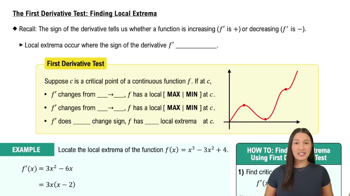
First Derivative Test

The First Derivative Test helps determine whether a critical point is a local maximum or minimum. By analyzing the sign of the derivative before and after the critical point, one can infer the behavior of the function. If the derivative changes from positive to negative, the point is a local maximum; if it changes from negative to positive, it is a local minimum.
Video consigliato:
07:09
The First Derivative Test: Finding Local Extrema

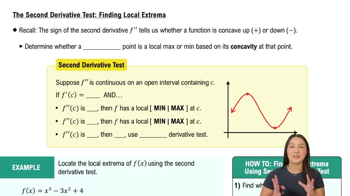
Second Derivative Test

The Second Derivative Test provides another method to classify critical points. If the second derivative at a critical point is positive, the function is concave up, indicating a local minimum. Conversely, if the second derivative is negative, the function is concave down, indicating a local maximum. If the second derivative is zero, the test is inconclusive.
Video consigliato:
06:02
The Second Derivative Test: Finding Local Extrema