Ch. 4 - Applications of Derivatives
Hass - Thomas' Calculus 15th Edition
Hass15th EditionThomas' CalculusISBN: 9780137616077Non è quello che usi tu?Cambia libro di testo
Capitolo 4, Problema 4.3.54a

Identifying Extrema


In Exercises 53–60:


a. Find the local extrema of each function on the given interval, and say where they occur.


f(x) = sin x − cos x,0 ≤ x ≤ 2π

Guida verificata passo dopo passo
1
First, find the derivative of the function f(x) = sin(x) - cos(x). The derivative, f'(x), is obtained by differentiating each term: f'(x) = cos(x) + sin(x).
Next, set the derivative equal to zero to find the critical points: cos(x) + sin(x) = 0. Solve this equation for x within the interval [0, 2π].
To solve cos(x) + sin(x) = 0, you can rewrite it as sin(x) = -cos(x). This can be expressed as tan(x) = -1, which gives the solutions x = 3π/4 and x = 7π/4 within the interval [0, 2π].
Evaluate the function f(x) at the critical points and at the endpoints of the interval. Calculate f(0), f(3π/4), f(7π/4), and f(2π).
Compare the values obtained in the previous step to determine the local extrema. The largest value is the local maximum, and the smallest value is the local minimum within the interval [0, 2π].

Risposta video verificata per un problema simile:

Questa soluzione video è stata consigliata dai nostri tutor come utile per risolvere questo problema.
Durata del video:
9m

Concetti chiave

Ecco i concetti essenziali che devi comprendere per rispondere correttamente alla domanda.

Local Extrema

Local extrema refer to the points in a function where it reaches a local maximum or minimum within a specific interval. To find these points, one typically examines the derivative of the function to identify critical points where the derivative is zero or undefined, and then uses the second derivative test or evaluates the function at these points to determine the nature of the extrema.
Video consigliato:
05:58
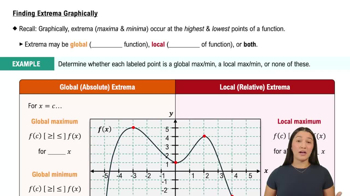
Finding Extrema Graphically

Derivative

The derivative of a function represents the rate at which the function's value changes with respect to changes in its input. It is a fundamental tool in calculus for analyzing the behavior of functions, particularly in finding critical points where the function's slope is zero, indicating potential local maxima or minima. For the function f(x) = sin x − cos x, the derivative helps identify where the function's slope changes direction.
Video consigliato:

Interval Analysis

Interval analysis involves examining the behavior of a function within a specified range of input values. In the context of finding extrema, it is crucial to consider the endpoints of the interval as well as any critical points within it. For the function f(x) = sin x − cos x on the interval 0 ≤ x ≤ 2π, this means evaluating the function at x = 0, x = 2π, and any critical points found within this range to determine where local extrema occur.
Video consigliato:
02:59
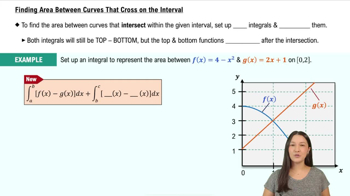
Finding Area Between Curves that Cross on the Interval