
Ch. 4 - Applications of Derivatives
Hass - Thomas' Calculus 15th Edition
Hass15th EditionThomas' CalculusISBN: 9780137616077Non è quello che usi tu?Cambia libro di testo
Capitolo 4, Problema 4.7.79

Initial Value Problems


Solve the initial value problems in Exercises 71–90.


dr/dθ = −π sin (πθ), r(0) = 0

Guida verificata passo dopo passo
1
Identify the given differential equation and initial condition: \( \frac{dr}{d\theta} = -\pi \sin(\pi \theta) \) with \( r(0) = 0 \).
Recognize that this is a first-order ordinary differential equation that can be solved by integrating both sides with respect to \( \theta \).
Set up the integral: \( r(\theta) = \int -\pi \sin(\pi \theta) \, d\theta + C \), where \( C \) is the constant of integration.
Perform the integration by using the substitution method or recalling the integral of \( \sin(kx) \), which is \( -\frac{1}{k} \cos(kx) \).
Apply the initial condition \( r(0) = 0 \) to solve for the constant \( C \), then write the final expression for \( r(\theta) \).

Risposta video verificata per un problema simile:

Questa soluzione video è stata consigliata dai nostri tutor come utile per risolvere questo problema.
Durata del video:
3m

Concetti chiave

Ecco i concetti essenziali che devi comprendere per rispondere correttamente alla domanda.

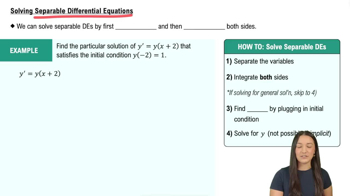
Separable Differential Equations

A separable differential equation can be written as a product of a function of one variable and a function of another, allowing variables to be separated on opposite sides of the equation. This technique simplifies solving by integrating each side independently.
Video consigliato:
06:06
Solving Separable Differential Equations

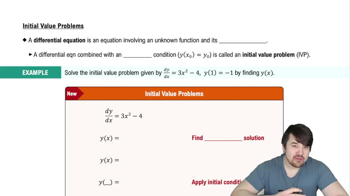
Initial Value Problems (IVP)

An initial value problem involves solving a differential equation with a given initial condition, which specifies the value of the unknown function at a particular point. This condition helps determine the unique solution among many possible ones.
Video consigliato:
Percorso guidato
05:03
Initial Value Problems

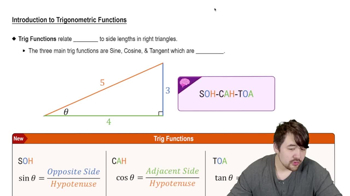
Integration of Trigonometric Functions

Solving differential equations involving trigonometric functions requires knowledge of integrating these functions, such as sine and cosine. Recognizing standard integrals and applying them correctly is essential to find the explicit solution.
Video consigliato:
Percorso guidato
6:04
Introduction to Trigonometric Functions
Pratica correlata
Domanda del libro di testo

Identify the inflection points and local maxima and minima of the functions graphed in Exercises 1–8. Identify the open intervals on which the functions are differentiable and the graphs are concave up and concave down.

8. y = 2cosx - √2x, -π≤x≤3π/2

215
views
Domanda del libro di testo

10. Catching rainwater A 1125 ft^3 open-top rectangular tank with a square base x ft on a side and y ft deep is to be built with its top flush with the ground to catch runoff water. The costs associated with the tank involve not only the material from which the tank is made but also an excavation charge proportional to the product xy.

a. If the total cost is c=5(x^2+4xy) + 10xy, what values of x and y will minimize it?

b. Give a possible scenario for the cost function in part (a).

215
views
Domanda del libro di testo

Finding Extrema from Graphs


In Exercises 7–10, find the absolute extreme values and where they occur.


321
views
Domanda del libro di testo

Each of Exercises 67–88 gives the first derivative of a continuous function y=f(x). Find y'' and then use Steps 2–4 of the graphing procedure described in this section to sketch the general shape of the graph of f.

82. y' = sin t, for 0 ≤ t ≤ 2π

116
views
Domanda del libro di testo

99. In Exercises 99 and 100, the graph of f' is given. Determine x-values corresponding to inflection points for the graph of f.

144
views
Domanda del libro di testo

Absolute Extrema on Finite Closed Intervals


In Exercises 37–40, find the function’s absolute maximum and minimum values and say where they occur.


g(θ) = θ³ᐟ⁵, −32 ≤ θ ≤ 1

240
views