
Ch. 4 - Applications of Derivatives
Hass - Thomas' Calculus 15th Edition
Hass15th EditionThomas' CalculusISBN: 9780137616077Non è quello che usi tu?Cambia libro di testo
Capitolo 4, Problema 53

Sketch the graphs of the rational functions in Exercises 53–60.
y= (x + 1) / (x - 3)

Guida verificata passo dopo passo
1
Identify the vertical asymptote by setting the denominator equal to zero: \(x - 3 = 0\). Solve for \(x\) to find \(x = 3\). This is where the function is undefined and the graph will have a vertical asymptote.
Determine the horizontal asymptote by comparing the degrees of the numerator and the denominator. Since both the numerator \((x + 1)\) and the denominator \((x - 3)\) are linear (degree 1), the horizontal asymptote is the ratio of the leading coefficients. Here, both coefficients are 1, so the horizontal asymptote is \(y = 1\).
Find the x-intercept by setting the numerator equal to zero: \(x + 1 = 0\). Solve for \(x\) to find \(x = -1\). This is where the graph crosses the x-axis.
Find the y-intercept by setting \(x = 0\) in the function: \(y = \frac{0 + 1}{0 - 3} = -\frac{1}{3}\). This is where the graph crosses the y-axis.
Sketch the graph using the asymptotes, intercepts, and the behavior of the function as \(x\) approaches the asymptotes. The graph will approach the vertical asymptote \(x = 3\) and the horizontal asymptote \(y = 1\) without crossing them.

Risposta video verificata per un problema simile:

Questa soluzione video è stata consigliata dai nostri tutor come utile per risolvere questo problema.
Durata del video:
8m

Concetti chiave

Ecco i concetti essenziali che devi comprendere per rispondere correttamente alla domanda.

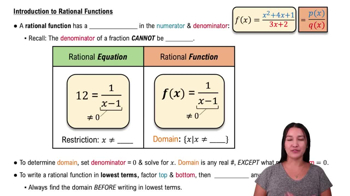
Rational Functions

A rational function is a ratio of two polynomials, expressed as f(x) = P(x)/Q(x), where P(x) and Q(x) are polynomials and Q(x) is not zero. Understanding the behavior of rational functions involves analyzing their asymptotes, intercepts, and domain. These functions can have vertical asymptotes where the denominator is zero and horizontal or oblique asymptotes based on the degrees of the polynomials.
Video consigliato:
6:04
Intro to Rational Functions

Vertical Asymptotes

Vertical asymptotes occur in rational functions at values of x that make the denominator zero, provided the numerator is not zero at those points. For the function y = (x + 1) / (x - 3), the vertical asymptote is at x = 3. As x approaches this value, the function's value tends to infinity or negative infinity, indicating a division by zero scenario.
Video consigliato:
Percorso guidato
3:40
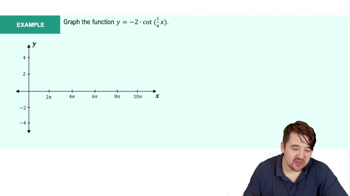
Introduction to Cotangent Graph Example 1

Horizontal Asymptotes

Horizontal asymptotes describe the behavior of a function as x approaches positive or negative infinity. For rational functions, if the degrees of the numerator and denominator are equal, the horizontal asymptote is the ratio of their leading coefficients. In y = (x + 1) / (x - 3), both polynomials are of degree 1, so the horizontal asymptote is y = 1, indicating the function approaches this line as x becomes very large or very small.
Video consigliato:
5:46
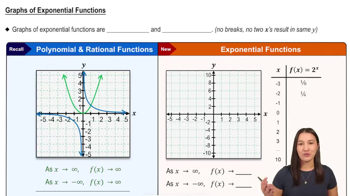
Graphs of Exponential Functions
Pratica correlata
Domanda del libro di testo

In Exercises 9–66, graph the function using appropriate methods from the graphing procedures presented just before Example 9, identifying the coordinates of any local extreme points and inflection points. Then find coordinates of absolute extreme points, if any.

56. y = x² + 2/x

201
views
Domanda del libro di testo

The range R of a projectile fired from the origin over horizontal ground is the distance from the origin to the point of impact. If the projectile is fired with an initial velocity at an angle with the horizontal, then in Chapter 13 we find that R-v_0^2/g(sin 2α) where g is the downward acceleration due to gravity. Find the angle α for which the range R is the largest possible.

242
views
Domanda del libro di testo

Sketch the graphs of the rational functions in Exercises 53–60.

y = (x2 + 1) / x                              

189
views
Domanda del libro di testo

In Exercises 9–66, graph the function using appropriate methods from the graphing procedures presented just before Example 9, identifying the coordinates of any local extreme points and inflection points. Then find coordinates of absolute extreme points, if any.

60. y = 5 / (x⁴ + 5)

111
views
Domanda del libro di testo

In Exercises 49–52, graph each function. Then use the function’s first derivative to explain what you see.

y = 𝓍²/³ + (𝓍―1)²/³ 

207
views
Domanda del libro di testo

Applications


Classical accounts tell us that a 170-oar trireme (ancient Greek or Roman warship) once covered 184 sea miles in 24 hours. Explain why at some point during this feat the trireme’s speed exceeded 7.5 knots (sea or nautical miles per hour).

168
views