Ch. 5 - Integrals
Hass - Thomas' Calculus 15th Edition
Hass15th EditionThomas' CalculusISBN: 9780137616077Non è quello che usi tu?Cambia libro di testo
Capitolo 5, Problema 5.PE.82

Find dy/dx if y = ∫(From cos x to 0) 1/(1 - t²) dt.


Explain the main steps in your calculation.

Guida verificata passo dopo passo
1
Recognize that the function y is defined as a definite integral with variable limits: \(y = \int_{\cos x}^{0} \frac{1}{1 - t^{2}} \, dt\).
Rewrite the integral by switching the limits to have the lower limit smaller than the upper limit, which changes the sign: \(y = - \int_{0}^{\cos x} \frac{1}{1 - t^{2}} \, dt\).
Apply the Leibniz rule for differentiation under the integral sign with variable limits. For \(y = \int_{a(x)}^{b(x)} f(t) \, dt\), the derivative is \(\frac{dy}{dx} = f(b(x)) \cdot b'(x) - f(a(x)) \cdot a'(x)\).
Since the integral now has fixed lower limit 0 and upper limit \(\cos x\), differentiate accordingly: \(\frac{dy}{dx} = - \frac{1}{1 - (\cos x)^{2}} \cdot (-\sin x)\), where \(b(x) = \cos x\) and \(b'(x) = -\sin x\).
Simplify the expression for \(\frac{dy}{dx}\) by carefully handling the negative signs and using the Pythagorean identity \(1 - \cos^{2} x = \sin^{2} x\) to express the derivative in simplest form.

Risposta video verificata per un problema simile:

Questa soluzione video è stata consigliata dai nostri tutor come utile per risolvere questo problema.
Durata del video:
3m

Concetti chiave

Ecco i concetti essenziali che devi comprendere per rispondere correttamente alla domanda.

Fundamental Theorem of Calculus

This theorem connects differentiation and integration, stating that if a function is defined as an integral with a variable limit, its derivative can be found by evaluating the integrand at that limit and multiplying by the derivative of the limit. It allows us to differentiate integrals with variable bounds.
Video consigliato:
Percorso guidato
06:11
Fundamental Theorem of Calculus Part 1

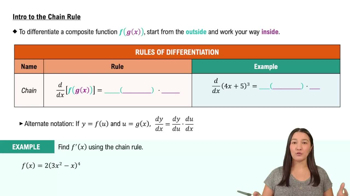
Chain Rule

The chain rule is used to differentiate composite functions. When the limit of integration is a function of x (like cos x), we must multiply the derivative of the integral's upper or lower limit by the derivative of that function to find dy/dx correctly.
Video consigliato:
05:02
Intro to the Chain Rule

Properties of Definite Integrals with Variable Limits

When the limits of a definite integral depend on x, the derivative involves evaluating the integrand at the limits and considering the sign based on whether the limit is upper or lower. Reversing limits changes the sign, which is important for correctly applying differentiation.
Video consigliato:
Percorso guidato
05:43
Definition of the Definite Integral