
Ch. 6 - Applications of Definite Integrals
Hass - Thomas' Calculus 15th Edition
Hass15th EditionThomas' CalculusISBN: 9780137616077Non è quello che usi tu?Cambia libro di testo
Capitolo 6, Problema 6.PE.21

Find the lengths of the curves in Exercises 19–22.
y = (5/12) x⁶/⁵ ― (5/8)x⁴/⁵ , 1 ≤ x ≤ 32

Guida verificata passo dopo passo
1
Recall the formula for the length of a curve defined by a function \(y = f(x)\) from \(x = a\) to \(x = b\): \[L = \int_{a}^{b} \sqrt{1 + \left(\frac{dy}{dx}\right)^2} \, dx\]
Identify the function given: \[y = \frac{5}{12} x^{\frac{6}{5}} - \frac{5}{8} x^{\frac{4}{5}}\] and the interval: \[1 \leq x \leq 32\]
Find the derivative \(\frac{dy}{dx}\) by differentiating each term using the power rule: \[\frac{dy}{dx} = \frac{5}{12} \cdot \frac{6}{5} x^{\frac{6}{5} - 1} - \frac{5}{8} \cdot \frac{4}{5} x^{\frac{4}{5} - 1}\] Simplify the coefficients and exponents carefully.
Substitute \(\frac{dy}{dx}\) into the arc length formula under the square root: \[\sqrt{1 + \left(\frac{dy}{dx}\right)^2}\] This expression will be the integrand for the length integral.
Set up the definite integral for the length of the curve: \[L = \int_{1}^{32} \sqrt{1 + \left(\frac{dy}{dx}\right)^2} \, dx\] At this point, you can simplify the integrand if possible, then evaluate the integral using appropriate methods (analytical or numerical).

Risposta video verificata per un problema simile:

Questa soluzione video è stata consigliata dai nostri tutor come utile per risolvere questo problema.
Durata del video:
6m

Concetti chiave

Ecco i concetti essenziali che devi comprendere per rispondere correttamente alla domanda.

Arc Length Formula

The arc length of a curve y = f(x) from x = a to x = b is found using the integral L = ∫_a^b √(1 + (dy/dx)²) dx. This formula calculates the distance along the curve by summing infinitesimal line segments, accounting for both horizontal and vertical changes.
Video consigliato:
Percorso guidato
06:29
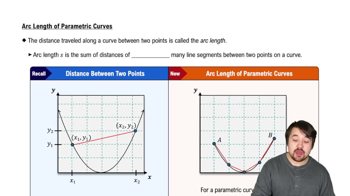
Arc Length of Parametric Curves

Derivative of a Function

The derivative dy/dx represents the rate of change or slope of the function y with respect to x. For the arc length, computing dy/dx is essential to determine how steep the curve is at each point, which affects the length calculation.
Video consigliato:
06:30
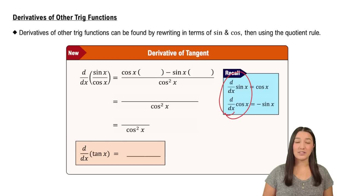
Derivatives of Other Trig Functions

Integration Techniques for Power Functions

Since the function involves fractional exponents, integrating the arc length expression requires familiarity with integrating power functions and possibly simplifying the integrand. Understanding how to handle fractional powers and algebraic manipulation is key to solving the integral.
Video consigliato:
07:32
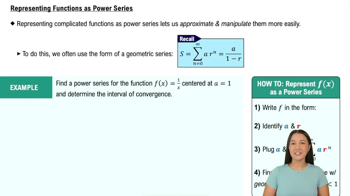
Representing Functions as Power Series
Pratica correlata
Domanda del libro di testo

Work


Assume that a spring does not follow Hooke’s Law. Instead, the force required to stretch the spring x ft from its natural length is ƒ(𝓍) = 10𝓍³/² lb . How much work does it take to

a. stretch the spring 4 ft from its natural length?

21
views
Domanda del libro di testo

Volumes

Find the volume of the solid generated by revolving the region bounded on the left by the parabola x = y² + 1 and on the right by the line x = 5 about

a. the x-axis

29
views
Domanda del libro di testo

Volumes

Find the volumes of the solids in Exercises 1–18.

The solid lies between planes perpendicular to the x-axis at x = π/4 and x = 5π/4. The cross-sections between these planes are circular disks whose diameters run from the curve y = 2 cos x to the curve y = 2 sin x.

36
views
Domanda del libro di testo

Volumes

Find the volume of the solid generated by revolving the region between the x-axis and curve y = x² ―2x about

b. the line y = ―1

48
views
Domanda del libro di testo

Volumes

Volume of a solid sphere hole A round hole of radius √3 ft is bored through the center of a solid sphere of radius 2 ft. Find the volume of material removed from the sphere.

44
views
Domanda del libro di testo

Volumes

Find the volumes of the solids in Exercises 1–18.

The solid lies between planes perpendicular to the x-axis at x = 0 and x = 4. The cross-sections of the solid perpendicular to the x-axis between these planes are circular disks whose diameters run from the curve x² = 4y to the curve y² = 4x.

28
views