
Ch. 6 - Applications of Definite Integrals
Hass - Thomas' Calculus 15th Edition
Hass15th EditionThomas' CalculusISBN: 9780137616077Non è quello che usi tu?Cambia libro di testo
Capitolo 6, Problema 6.PE.8a

Volumes
Find the volume of the solid generated by revolving the “triangular” region bounded by the curve y = 4/x³ and the lines x = 1 and y = 1/2 about
a. the x-axis

Guida verificata passo dopo passo
1
First, identify the region bounded by the curve \(y = \frac{4}{x^3}\), the vertical line \(x = 1\), and the horizontal line \(y = \frac{1}{2}\). To find the limits of integration, determine the \(x\)-values where \(y = \frac{1}{2}\) intersects the curve by solving \(\frac{4}{x^3} = \frac{1}{2}\).
Solve for \(x\) in the equation \(\frac{4}{x^3} = \frac{1}{2}\) to find the lower limit of integration. This will give you the interval \([a, 1]\) over which the region is bounded, where \(a\) is the solution to the equation.
Set up the volume integral using the disk method since the solid is generated by revolving the region around the x-axis. The volume \(V\) is given by \(V = \pi \int_a^1 [f(x)]^2 \, dx\), where \(f(x)\) is the function representing the radius of the disks, which in this case is \(y = \frac{4}{x^3}\).
Write the integral explicitly as \(V = \pi \int_a^1 \left( \frac{4}{x^3} \right)^2 \, dx = \pi \int_a^1 \frac{16}{x^6} \, dx\). This integral represents the volume of the solid formed by revolving the region around the x-axis.
Evaluate the integral \(\int_a^1 \frac{16}{x^6} \, dx\) by applying the power rule for integration, then multiply the result by \(\pi\) to express the volume. Remember to substitute the limits \(a\) and \(1\) after integrating.

Risposta video verificata per un problema simile:

Questa soluzione video è stata consigliata dai nostri tutor come utile per risolvere questo problema.
Durata del video:
7m

Concetti chiave

Ecco i concetti essenziali che devi comprendere per rispondere correttamente alla domanda.

Volume of Solids of Revolution

This concept involves finding the volume of a 3D solid formed by rotating a 2D region around an axis. The volume is typically calculated using integral methods such as the disk/washer or shell method, depending on the axis of rotation and the shape of the region.
Video consigliato:
04:48
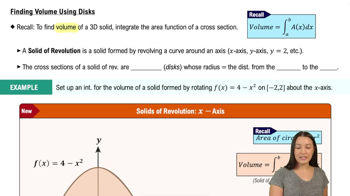
Finding Volume Using Disks

Disk/Washer Method

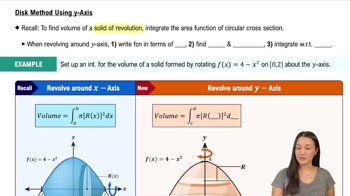
The disk/washer method calculates volume by slicing the solid perpendicular to the axis of rotation, forming circular cross-sections. The volume is found by integrating the area of these disks or washers, which are circles or rings, across the interval of interest.
Video consigliato:
06:30
Disk Method Using y-Axis

Setting Up Integration Limits and Boundaries

Accurately determining the limits of integration and the boundaries of the region is crucial. This involves understanding the given curves and lines, solving for intersection points, and expressing the radius of rotation in terms of the variable of integration.
Video consigliato:
Percorso guidato
11:11
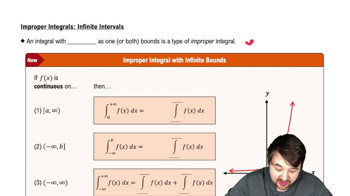
Improper Integrals: Infinite Intervals