Ch. 7 - Transcendental Functions
Hass - Thomas' Calculus 15th Edition
Hass15th EditionThomas' CalculusISBN: 9780137616077Non è quello che usi tu?Cambia libro di testo
Capitolo 7, Problema 7.PE.110a

110. Does f grow faster, slower, or at the same rate as g as x→∞? Give reasons for your answers.
a. f(x) = 3^(-x), g(x) = 2^(-x)

Guida verificata passo dopo passo
1
Identify the behavior of each function as \( x \to \infty \). For \( f(x) = 3^{-x} \), rewrite it as \( f(x) = \left( \frac{1}{3} \right)^x \). Similarly, for \( g(x) = 2^{-x} \), rewrite it as \( g(x) = \left( \frac{1}{2} \right)^x \).
Recognize that both functions are exponential decay functions because their bases \( \frac{1}{3} \) and \( \frac{1}{2} \) are between 0 and 1, so both approach 0 as \( x \to \infty \).
To compare their rates of decay, consider the bases: \( \frac{1}{3} \approx 0.333 \) and \( \frac{1}{2} = 0.5 \). Since \( 0.333 < 0.5 \), \( f(x) \) decreases faster than \( g(x) \).
Another way to compare growth rates is to look at the limit of their ratio as \( x \to \infty \): calculate \( \lim_{x \to \infty} \frac{f(x)}{g(x)} = \lim_{x \to \infty} \frac{(1/3)^x}{(1/2)^x} = \lim_{x \to \infty} \left( \frac{1/3}{1/2} \right)^x = \lim_{x \to \infty} \left( \frac{2}{3} \right)^x \).
Since \( \frac{2}{3} < 1 \), this limit approaches 0, which confirms that \( f(x) \) goes to zero faster than \( g(x) \) as \( x \to \infty \). Therefore, \( f \) grows slower (decays faster) than \( g \) as \( x \to \infty \).

Risposta video verificata per un problema simile:

Questa soluzione video è stata consigliata dai nostri tutor come utile per risolvere questo problema.
Durata del video:
3m

Concetti chiave

Ecco i concetti essenziali che devi comprendere per rispondere correttamente alla domanda.

Exponential Functions and Their Growth Rates

Exponential functions have the form a^x, where the base a determines the growth or decay rate. For bases between 0 and 1, the function represents exponential decay, decreasing as x increases. Comparing two such functions involves analyzing their bases to determine which decays faster.
Video consigliato:
09:29
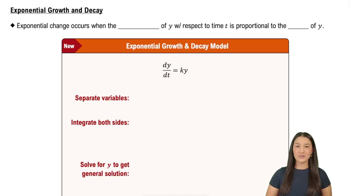
Exponential Growth & Decay

Limits at Infinity

The limit of a function as x approaches infinity describes its long-term behavior. For exponential decay functions, the limit approaches zero, but the rate at which they approach zero depends on the base. Understanding limits helps compare how quickly functions approach zero.
Video consigliato:
03:07
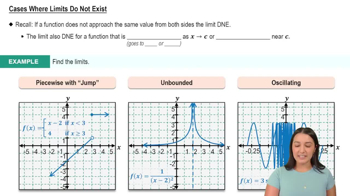
Cases Where Limits Do Not Exist

Comparing Rates of Decay Using Dominance

When comparing two functions as x→∞, the function with the smaller base in exponential decay decreases faster. This concept of dominance helps determine which function grows slower or faster by examining which tends to zero more rapidly.
Video consigliato:
Percorso guidato
04:16
Intro To Related Rates