Ch. 7 - Transcendental Functions
Hass - Thomas' Calculus 15th Edition
Hass15th EditionThomas' CalculusISBN: 9780137616077Non è quello che usi tu?Cambia libro di testo
Capitolo 7, Problema 7.PE.133

133. What is the age of a sample of charcoal in which 90% of the carbon-14 originally present has decayed?

Guida verificata passo dopo passo
1
Understand that the problem involves radioactive decay, where the amount of carbon-14 decreases over time according to an exponential decay model.
Recall the decay formula: \(N(t) = N_0 \times e^{-\lambda t}\), where \(N(t)\) is the amount of carbon-14 remaining at time \(t\), \(N_0\) is the original amount, and \(\lambda\) is the decay constant.
Since 90% of the carbon-14 has decayed, only 10% remains, so set \(\frac{N(t)}{N_0} = 0.10\) and write the equation \(0.10 = e^{-\lambda t}\).
Take the natural logarithm of both sides to solve for \(t\): \(\ln(0.10) = -\lambda t\), which gives \(t = -\frac{\ln(0.10)}{\lambda}\).
Use the known half-life of carbon-14 (about 5730 years) to find \(\lambda\) using \(\lambda = \frac{\ln(2)}{\text{half-life}}\), then substitute \(\lambda\) back into the equation to calculate \(t\).

Risposta video verificata per un problema simile:

Questa soluzione video è stata consigliata dai nostri tutor come utile per risolvere questo problema.
Durata del video:
4m

Concetti chiave

Ecco i concetti essenziali che devi comprendere per rispondere correttamente alla domanda.

Radioactive Decay and Half-Life

Radioactive decay is the process by which unstable nuclei lose particles over time, decreasing the amount of a radioactive isotope. The half-life is the time required for half of the original radioactive atoms to decay. Understanding half-life allows us to relate the remaining amount of a substance to the elapsed time.
Video consigliato:
09:29
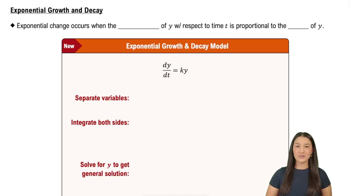
Exponential Growth & Decay

Carbon-14 Dating Method

Carbon-14 dating estimates the age of organic materials by measuring the remaining carbon-14 isotope, which decays at a known rate. Since living organisms constantly replenish carbon-14, the decrease after death indicates elapsed time. This method is widely used in archaeology and geology.
Video consigliato:
07:33
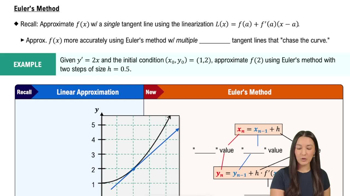
Euler's Method

Exponential Decay Formula

The exponential decay formula, N(t) = N_0 * (1/2)^(t/T), relates the remaining quantity N(t) to the initial amount N_0, elapsed time t, and half-life T. This formula helps calculate the age of a sample when the fraction of remaining radioactive material is known.
Video consigliato:
09:29
Exponential Growth & Decay