Ch. 7 - Transcendental Functions
Hass - Thomas' Calculus 15th Edition
Hass15th EditionThomas' CalculusISBN: 9780137616077Non è quello che usi tu?Cambia libro di testo
Capitolo 7, Problema 7.4.43

43. Surrounding medium of unknown temperature A pan of warm water (46°C) was put in a refrigerator. Ten minutes later, the water’s temperature was 39°C; 10 min after that, it was 33°C. Use Newton’s Law of Cooling to estimate how cold the refrigerator was.

Guida verificata passo dopo passo
1
Identify the variables and given data: initial temperature of the water \(T_0 = 46^\circ C\), temperature after 10 minutes \(T(10) = 39^\circ C\), temperature after 20 minutes \(T(20) = 33^\circ C\), and the unknown surrounding temperature \(T_s\) (the refrigerator temperature).
Recall Newton's Law of Cooling formula: \(T(t) = T_s + (T_0 - T_s) e^{-kt}\), where \(k\) is a positive constant related to the cooling rate, and \(t\) is time in minutes.
Set up two equations using the temperatures at \(t=10\) and \(t=20\): \(39 = T_s + (46 - T_s) e^{-10k}\) \(33 = T_s + (46 - T_s) e^{-20k}\)
Divide the second equation by the first to eliminate \((46 - T_s)\) and solve for \(e^{-10k}\): \(\frac{33 - T_s}{39 - T_s} = e^{-10k}\)
Use the expression for \(e^{-10k}\) in one of the original equations to solve for \(T_s\), the refrigerator temperature.

Risposta video verificata per un problema simile:

Questa soluzione video è stata consigliata dai nostri tutor come utile per risolvere questo problema.
Durata del video:
8m

Concetti chiave

Ecco i concetti essenziali che devi comprendere per rispondere correttamente alla domanda.

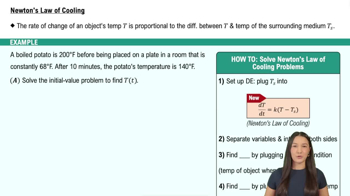
Newton's Law of Cooling

Newton's Law of Cooling states that the rate of change of an object's temperature is proportional to the difference between its temperature and the surrounding medium's temperature. Mathematically, it is expressed as dT/dt = -k(T - T_env), where k is a positive constant. This law models how objects cool or warm over time toward the ambient temperature.
Video consigliato:
10:44
Newton's Law of Cooling

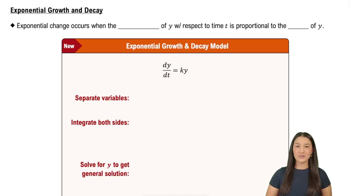
Exponential Decay in Temperature

The temperature difference between the object and the environment decreases exponentially over time according to Newton's Law of Cooling. This means the temperature T(t) can be modeled as T_env + (T_initial - T_env) * e^(-kt), where T_env is the ambient temperature, and k is the cooling constant. Understanding this helps in solving for unknown variables like ambient temperature.
Video consigliato:
09:29
Exponential Growth & Decay

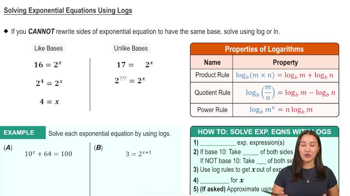
Solving for Unknown Parameters Using Data Points

Given temperature measurements at different times, one can set up equations based on the cooling model to solve for unknowns such as the ambient temperature and cooling constant. This involves using the exponential decay formula with the known temperatures and times, then solving the resulting system of equations algebraically or numerically.
Video consigliato:
5:47
Solving Exponential Equations Using Logs