Ch. 7 - Transcendental Functions
Hass - Thomas' Calculus 15th Edition
Hass15th EditionThomas' CalculusISBN: 9780137616077Non è quello che usi tu?Cambia libro di testo
Capitolo 7, Problema 8.2.42

Evaluate the integrals in Exercises 31–56. Some integrals do not require integration by parts.
∫ sin(2x) cos(4x) dx

Guida verificata passo dopo passo
1
Recognize that the integral involves the product of sine and cosine functions with different arguments: \(\int \sin(2x) \cos(4x) \, dx\).
Recall the product-to-sum identities, which help simplify products of sine and cosine into sums of trigonometric functions. Specifically, use the identity: \(\sin A \cos B = \frac{1}{2} [\sin(A+B) + \sin(A-B)]\).
Apply the identity to rewrite the integral as: \(\int \sin(2x) \cos(4x) \, dx = \int \frac{1}{2} [\sin(2x + 4x) + \sin(2x - 4x)] \, dx = \frac{1}{2} \int [\sin(6x) + \sin(-2x)] \, dx\).
Simplify the expression inside the integral, noting that \(\sin(-2x) = -\sin(2x)\), so the integral becomes \(\frac{1}{2} \int [\sin(6x) - \sin(2x)] \, dx\).
Now, integrate each sine term separately using the basic integral formula \(\int \sin(kx) \, dx = -\frac{1}{k} \cos(kx) + C\). Write the integral as the sum of these two integrals and proceed accordingly.

Risposta video verificata per un problema simile:

Questa soluzione video è stata consigliata dai nostri tutor come utile per risolvere questo problema.
Durata del video:
2m

Concetti chiave

Ecco i concetti essenziali che devi comprendere per rispondere correttamente alla domanda.

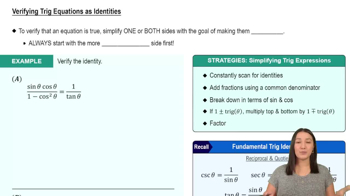
Trigonometric Identities

Trigonometric identities, such as product-to-sum formulas, allow the transformation of products of sine and cosine functions into sums or differences of trigonometric functions. For example, sin(A)cos(B) = ½[sin(A+B) + sin(A−B)], which simplifies integration by converting complex products into easier integrals.
Video consigliato:
7:17
Verifying Trig Equations as Identities

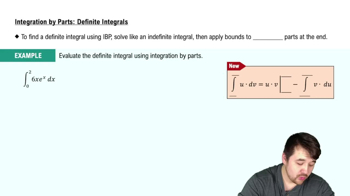
Integration Techniques

Integration techniques include methods like substitution, integration by parts, and recognizing standard integral forms. Knowing when to apply these methods or when simpler identities suffice is crucial for efficiently solving integrals involving trigonometric functions.
Video consigliato:
Percorso guidato
06:18
Integration by Parts for Definite Integrals

Definite and Indefinite Integrals

Understanding the difference between definite and indefinite integrals is essential. Indefinite integrals represent families of functions plus a constant of integration, while definite integrals compute the net area under a curve between limits. This problem involves an indefinite integral requiring an antiderivative.
Video consigliato:
Percorso guidato
05:43
Definition of the Definite Integral