Ch. 7 - Transcendental Functions
Hass - Thomas' Calculus 15th Edition
Hass15th EditionThomas' CalculusISBN: 9780137616077Non è quello che usi tu?Cambia libro di testo
Capitolo 7, Problema 7.6.73

Evaluate the integrals in Exercises 53–76.
73. ∫(from 0 to ln√3) e^x dx/(1+e^(2x))

Guida verificata passo dopo passo
1
Recognize the integral to evaluate: \(\int_0^{\ln \sqrt{3}} \frac{e^x}{1 + e^{2x}} \, dx\).
Make a substitution to simplify the integral. Let \(u = e^x\). Then, the differential is \(du = e^x \, dx\), which means \(e^x \, dx = du\).
Rewrite the integral in terms of \(u\). The limits change as follows: when \(x = 0\), \(u = e^0 = 1\); when \(x = \ln \sqrt{3}\), \(u = e^{\ln \sqrt{3}} = \sqrt{3}\). The integral becomes \(\int_1^{\sqrt{3}} \frac{1}{1 + u^2} \, du\).
Recognize that \(\int \frac{1}{1 + u^2} \, du\) is the standard integral for \(\arctan u + C\). So, the integral evaluates to \(\arctan u\) evaluated from \(1\) to \(\sqrt{3}\).
Apply the Fundamental Theorem of Calculus by substituting the limits back into \(\arctan u\) to express the definite integral as \(\arctan(\sqrt{3}) - \arctan(1)\).

Risposta video verificata per un problema simile:

Questa soluzione video è stata consigliata dai nostri tutor come utile per risolvere questo problema.
Durata del video:
4m

Concetti chiave

Ecco i concetti essenziali che devi comprendere per rispondere correttamente alla domanda.

Definite Integrals

A definite integral calculates the net area under a curve between two specific limits. It involves evaluating the antiderivative at the upper and lower bounds and subtracting these values. This concept is essential for solving integrals with given limits, such as from 0 to ln(√3).
Video consigliato:
Percorso guidato
05:43
Definition of the Definite Integral

Substitution Method

The substitution method simplifies integrals by changing variables to transform the integral into a more manageable form. It often involves setting a part of the integrand as a new variable, which helps in integrating complex expressions like those involving exponential functions.
Video consigliato:
07:33
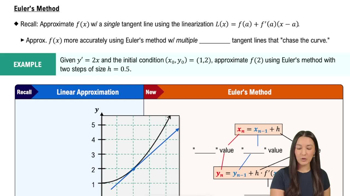
Euler's Method

Properties of Exponential Functions

Exponential functions, such as e^x, have unique properties including their derivatives and integrals being proportional to themselves. Understanding how to manipulate expressions like e^(2x) and their relationships is crucial for simplifying and evaluating integrals involving exponentials.
Video consigliato:
Percorso guidato
06:21
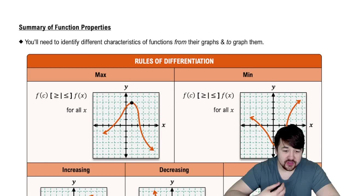
Properties of Functions