22. The function ln x grows slower than any polynomial Show that ln(x) grows slower as x→∞ than any nonconstant polynomial.
Ch. 7 - Transcendental Functions
Capitolo 7, Problema 7.3.119
In Exercises 115–126, use logarithmic differentiation or the method in Example 6 to find the derivative of y with respect to the given independent variable.
119. y = (sin x)ˣ
Guida verificata passo dopo passo1
Recognize that the function is of the form \(y = (\sin x)^x\), which is a variable base raised to a variable exponent. This is a perfect candidate for logarithmic differentiation.
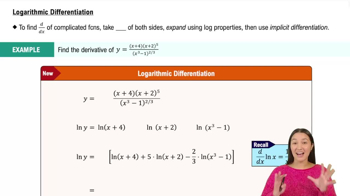
Take the natural logarithm of both sides to simplify the expression: \(\ln y = \ln \left( (\sin x)^x \right)\).
Use the logarithm power rule to bring the exponent down: \(\ln y = x \cdot \ln (\sin x)\).
Differentiate both sides with respect to \(x\). Remember to use implicit differentiation on the left side and the product rule on the right side: \(\frac{1}{y} \frac{dy}{dx} = \frac{d}{dx} \left( x \ln (\sin x) \right)\).
Apply the product rule to the right side: \(\frac{d}{dx} \left( x \ln (\sin x) \right) = 1 \cdot \ln (\sin x) + x \cdot \frac{1}{\sin x} \cdot \cos x\). Then multiply both sides by \(y\) to solve for \(\frac{dy}{dx}\).

Risposta video verificata per un problema simile:
Questa soluzione video è stata consigliata dai nostri tutor come utile per risolvere questo problema.
Durata del video:
3mConcetti chiave
Ecco i concetti essenziali che devi comprendere per rispondere correttamente alla domanda.
Logarithmic Differentiation
Logarithmic differentiation is a technique used to differentiate functions where the variable appears both in the base and the exponent, such as y = (sin x)^x. By taking the natural logarithm of both sides, the expression simplifies to a product, making it easier to apply differentiation rules.
Video consigliato:
Logarithmic Differentiation
Chain Rule
The chain rule is a fundamental differentiation rule used when differentiating composite functions. In this problem, it helps differentiate expressions like ln(sin x) and sin x, which are nested inside other functions, by multiplying the derivative of the outer function by the derivative of the inner function.
Video consigliato:
Intro to the Chain Rule
Implicit Differentiation
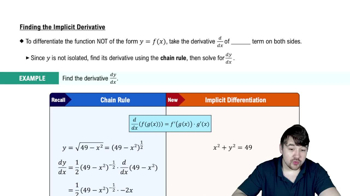
Implicit differentiation involves differentiating both sides of an equation with respect to the independent variable, treating y as a function of x. After taking logarithms, y is expressed implicitly, and this method helps find dy/dx by differentiating terms involving y and x together.
Video consigliato:
Percorso guidato
Finding The Implicit Derivative
Pratica correlata
Domanda del libro di testo
37
views
Domanda del libro di testo
Each of Exercises 25–36 gives a formula for a function y=f(x). In each case, find f^(-1)(x) and identify the domain and range of f^(-1). As a check, show that f(f^(-1)(x))=f^(-1)(f(x))=x.
f(x) = x⁵
16
views
Domanda del libro di testo
Find the limits in Exercises 13–20. (If in doubt, look at the function’s graph.)
15. lim(x→∞)arctan(x)
28
views
Domanda del libro di testo
In Exercises 1–4, show that each function y=f(x) is a solution of the accompanying differential equation.
3. y = 1/x ∫(from 1 to x) e^t/t dt, x²y' + xy = e^x
14
views
Domanda del libro di testo
L’Hôpital’s Rule
Find the limits in Exercises 103–110.
108. lim(x→∞)(e^x arctan(e^x))/(e^(2x)+x)
24
views
Domanda del libro di testo
In Exercises 13–24, find the derivative of y with respect to the appropriate variable.
15. y = 2√t tanh(√t)
21
views